
















Australia stands at a crossroads. As one of the world’s richest nations, we have the resources and talent to lead in deep tech innovation.
The Federal Government’s ‘Future Made in Australia’ policy is also a welcome starting commitment to fostering local innovation, supporting emerging technologies, and building a resilient economy.
But to shift our economy from its current reliance on services and resources to one driven by manufacturing, science, and engineering, government policy is just one of many critical levers we must pull.
Multiple stakeholders must invest in deep tech simultaneously: investors, industry leaders, policymakers, and innovators alike to transform industries, create jobs, build manufacturing sovereignty, and ensure long-term economic growth in the process.
Critically we must stop looking overseas for the talent to build these solutions when we have more than enough in our own backyard.
Equal to Israel and Silicon Valley
Australia has just as much talent and innovation onshore than what can be found in Israel or Silicon Valley – just consider homegrown successes like Google Maps, WiFi, ultrasounds, cochlear implants, blackbox, penicillin, Gardasil (an HPV vaccine) – the list goes on.
The 23 startups featured at Tech23 are not just dreaming but building a future that is more sustainable, more profitable, and infinitely more impactful.
Their groundbreaking work is leading to more resilient food systems, smarter and greener urban spaces, better health outcomes, an advanced industrial future, and reduced environmental footprints.
Doing this requires breaking down silos and taking a multi-sectoral approach..
A great example is Rux Energy whose development of a new material for hydrogen storage must work alongside those in industry producing hydrogen.
Governments must also play a role in procurement and early stage investment. Disappointingly, however, it’s often overseas governments that are often the first procurers of Australian deep tech innovations – clearly because they recognise the quality of what we are producing.
A deep tech revolution
Various inflection points in history trigger industrial revolutions, and I believe we have now entered a deep tech revolution which urgently calls for a systems-based collaborative approach.
A great example was our response to COVID-19 when the world came together – governments, industry, innovators, investors – and collaboratively tackled a global problem in a way we hadn’t really seen before.
This same approach must now urgently be taken to tackling other increasingly complex and interconnected global problems such as climate change, food security and sovereignty, ageing populations, and more.
And I strongly believe that the deep tech startups that will be most successful at doing this are currently doing two things simultaneously.
Zooming in – and out
On the one hand they are being hyper-focused on the problem they’re solving and the technology they’re building, zooming in on one single aspect of the issue.
For instance, Tech23 startup Nourish Ingredients isn’t solving the entirety of our food security problem. They are focused on building resilience into the food supply chain through potent, animal-free fats that boost food performance and production with fewer or no animal ingredients.
On the other hand, these same startups are also zooming out to look at where the business appetite for their technology is heading, where government investment and policy is shifting, whether there is societal momentum driving regulatory change that will work for or against them. And then they are inserting themselves into these conversations 10 years in advance of when their technology will actually be in market, in order to influence the conditions that will lead to their success.
The foresight required for this is incredible.
For instance, Google Maps wasn’t invented on our tiny smartphones where it’s most commonly used now – it was first developed on a clunky desktop computer at a time when smartphones didn’t even exist. But there was this vision of one day confidently navigating the streets using a futuristic technology that would be developed alongside Google Maps itself.
Only through a systems-based, decadal approach will we build not just the businesses but also the industries of the future.
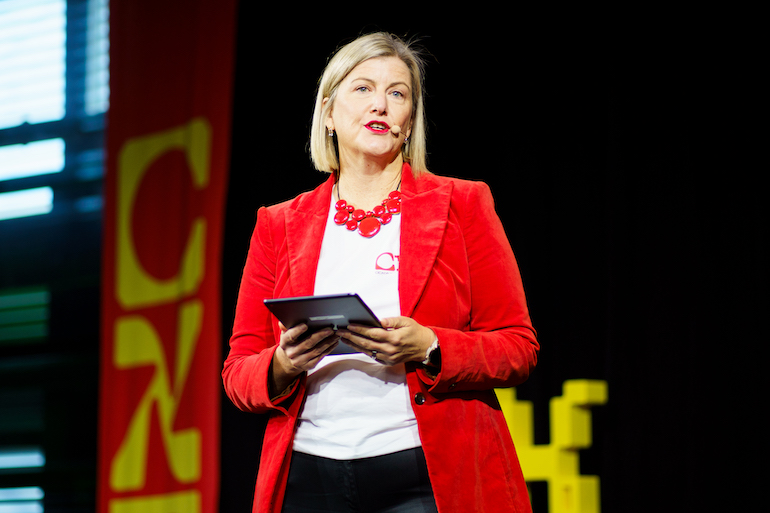
- Sally-Ann Williams is CEO of deep tech incubator Cicada Innovations and custodian of deep tech festival Cicada x Tech23. This was her opening address at the event on August 7.





Daily startup news and insights, delivered to your inbox.