


















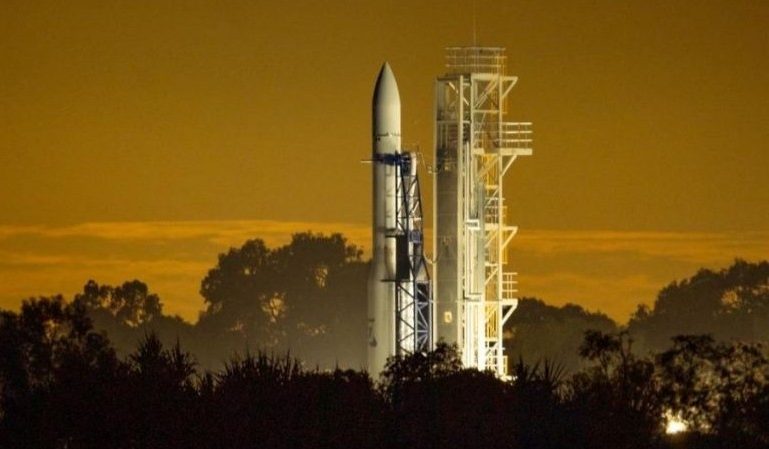
After a week of excited build up, Queensland’s Gilmour Space Technologies was forced to postpone its mission to send an Australian-made rocket into orbit this week – a feat that would have made history.
Gilmour Space’s first launch window opened on Thursday but the rocket stayed silent at the Bowen Orbital Spaceport – about 200km outside Townsville – due to an issue with a ground support system.
On Friday morning, an electrical fault caused the Eris rocket’s nose cone to open surprisingly, slamming shut its chance to get the rocket airborne, and its sole payload – a single jar of Vegemite – into space.
“This happened before any fuel was loaded into the vehicle,” Gilmour Space said in a statement. “Most importantly, no one was injured, and early checks show no damage to the rocket or the launch pad.
“We have a replacement nose cone in our factory on the Gold Coast that will be sent to the launch site and installed after a full investigation into what caused the issue.”
It was a disappointing end to Gilmour’s hopes of making history this month, with the company’s rocket scientists now forced back to the lab to investigate and prepare for the next launch which is likely to be at least three weeks away.
Ahead of this week’s launch, CEO Adam Gilmour set expectations by saying delays were “a normal part of rocket launches”, and that “safety is always the top priority”.
“The first launch is always the hardest,” he said. “Reaching orbit is a highly complex engineering challenge, and every successful rocket company has faced setbacks in their early attempts—SpaceX, for one, did it on their fourth attempt. It’s almost unheard of for a private rocket company to launch successfully to orbit the first time.”
He spruiked the importance of this launch as a means of demonstrating sovereign capability: Gilmour Space is vertically integrated in Australia from the proprietary hybrid rocket technology to the orbital buses, even the spaceport is owned by the firm.
“This is the road we must take to build sovereign space capability that’s critical for Australia’s future. Launching Australian-owned and controlled rockets from home soil means more high-tech jobs, greater security, economic growth, and technological independence,” Gilmour said.
“Only six countries in the world are launching regularly to space using their own technology, and Australia could soon be one of them.”
In the relatively short history of space flight, just 12 countries have developed the capability of launching locally made rockets to orbit, with South Korea the most recent addition to that list in 2013.
Since Gilmour Space was founded in 2013, the spacetech startup has grown to more than 200 employees, built a local supply chain of more than 300 Australian companies, raised $142 million in venture funding, including $19 million Series B in 2018 and $61 million in a Series C in June 2021 and earlier this year, a $55 million Series D, as well as attracting tens of millions in funding from local, state and federal governments.






Daily startup news and insights, delivered to your inbox.