


















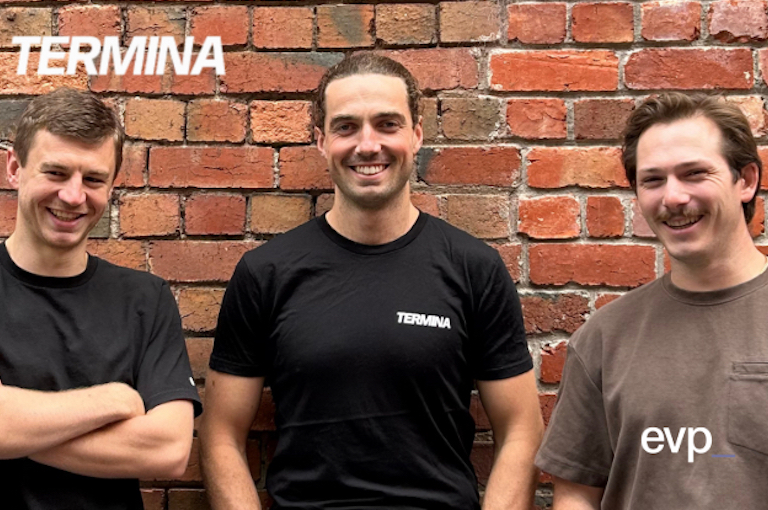
Termina, a software startup that helps small business get cheaper energy prices through collective buying, has raised $3 million in a pre-Series A.
The round was led by Sydney VC EVP, via its Fund IV, with support from existing investors Archangel Ventures and Skalata.
The five-year-old Melbourne startup plans to expand globally, with eyes on the UK after already launching in New Zealand, as well as improving the platform to help clients manage their energy data across multiple sites and track and report emissions. They’re also looking to build stronger ties with the renewable energy sector, as well as improving their buying power to deliver lower energy costs.
Founded (as Threadlet) in 2020 by Michael Koopman (CEO), Rodrigo Garcia-Mulder (head of sales), and Tom Dempster (CTO), Termina already has several well-known brands amid more than 900 clients, including Betty’s Burgers, Pizza Hut, Coffee Club, Lord of the Fries, and the Uniting Church community services organisation Uniting Vic.Tas.
Sectors such as hospitality, retail, childcare and healthcare clinics are potential areas for expansion.
Termina’s vision is to create net zero cost and emissions energy through its centralised software for SMEs to manage and procure energy related products.
The platform has begun to carve out a slice of the power pie, managing more than 4,000 of the 4.5 million energy meters in Australia, spending around $3.6 million a month, consolidating energy data, bills, payments and accounts into one system. Annual recurring revenue has doubled over 12 months.
Koopman, who studied chemistry and briefly flirted with life as a researcher in the battery sector, before a stint at the Australian Energy Market Operator (AEMO), describes himself as a “mediocre software engineer”, having built v.1 of Termina’s software. He’s happy to have his BFFs onboard as cofounders.
“I find myself very lucky that whenever people ask me about what it’s like starting a business and running a business, especially with mates,” he said.
“I think I’m the luckiest bloke in the world because I’ve started with two of my best mates, and we get to hang out every day while building something pretty cool.”
Termina flips the incentive on finding the best deal for its customers. Traditionally, brokers are paid a commission on the contract by the energy retailer. Koopman says that makes the customer the product. His startup is paid based on the savings it generates, aligning its goals with its customers, and keeping them attuned to changes in the market and costs.
“Our platform unites previously isolated small businesses in a way that hasn’t been possible before,” he said.
“Through collective purchasing power, businesses can even the playing field of energy pricing disparities in Australia. Our customers are automatically switched to the best energy plan for their specific business needs without time consuming and frustrating phone calls to providers. The platform simplifies their invoicing and management processes while delivering significant savings with zero ongoing effort.”
Most Termina customers have saved more than $2,300 annually on their energy bills.
Koopman’s eye is on the energy transition to renewables and the changes that has wrought to who supplies power – especially businesses generating their own power. Traditionally, energy is an operational expenditure line item, but installing solar and batteries moves it more to the capex side of the ledger, he believes. He wants to expand Termina’s coverage of energy products and services, providing a comprehensive energy management solution.
“We really want to help brick and mortar businesses to move the thinking of energy from a cost into an asset for their business, so they can reduce their emissions while reducing their costs and just help them win,” Koopman said.
Energy as capital investment
The Termina CEO wants to position the business to not only centralise energy data across multiple sites, and track and report emissions, but also analyse the return on investment from renewables to make bettter decisions on energy upgrades.
“Businesses aren’t equipped to make these decisions. Because every business has been structured to just take it as a line item in their OpEx. But now, it’s becoming a capital expenditure,” he said.
In the meantime, Koopman’s seen value in his investors, saying that alongside making a quick decision, they brought value to the board “in terms of the focus on what’s going to add the most value”.
“We really appreciate that that relationship already of them being able to come to room, get up to speed with the business really quickly, and help us focus in on what is going to move the needle the most. And that’s part of the reason why we went with them, because we we’d heard from other founders as well that EVP were genuinely a really good value add to the board.”
EVP’s Allen Zhu said Termina is pioneering a fundamentally different approach in the Australian energy market.
“After first meeting the company in 2023, we’ve closely tracked their growth and impressive customer retention for over two years,” he said.
“We’re confident that Michael, Rodrigo, and Tom have built a genuinely user-centric platform that delivers sustainable, long-term value to customers.”
Koopman believes Termina has the potential to transform small business when it comes to one of their biggest pain points – the price of power.
“There’s something really fulfilling about being the potential difference for a small business from being unprofitable and profitable, if we’re able to reduce the energy spend by 10, 15%,” he said.
More at termina.io







Daily startup news and insights, delivered to your inbox.