


















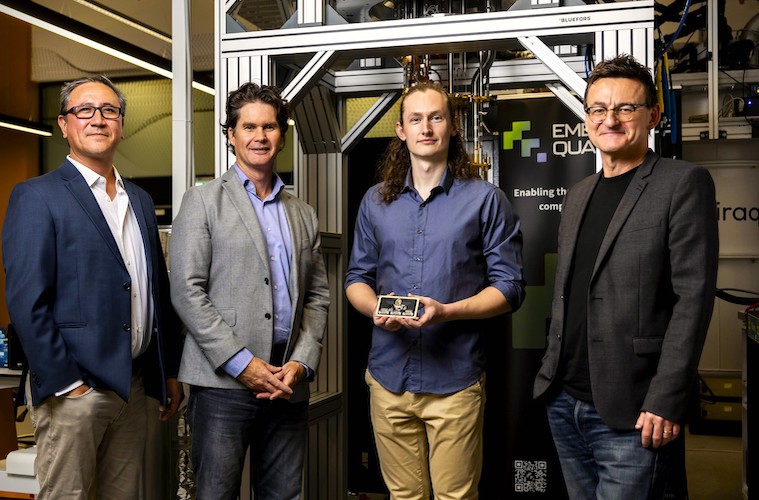
Two Sydney quantum startups have combined forces to developed technology that effectively reduces the size of the circuits required to run a silicon-based quantum computer.
Diraq and Emergence Quantum published details in Nature today.
Quantum bits (or ‘qubits’) must be held at cryogenic temperatures, near absolute zero (–273.15 °C), to preserve their information. But they also need to be controlled and measured by complex electronics built from the complementary metal oxide semiconductor (CMOS) circuits found in laptops and smart phones.
But unlike qubits, the CMOS circuits are usually designed to work at room temperature and when placed close to the qubits, they can heat them, degrading their performance. While the two can be seperated by long cables, the millions of qubits required for practical quantum computing make it unfeasible.
Diraq’s silicon ‘quantum dot’ technology combined with ‘cryo-CMOS’ technology developed by Emergence Quantum, which does not compromise the performance of Diraq’s qubits.
The research began as an academic endeavour between the University of Sydney and UNSW Sydney, in collaboration with Diraq.
The results come follow the recent founding of Emergence Quantum by Professor David Reilly and Dr Thomas Ohki at the University of Sydney, formerly part of Microsoft.
Prof Reilly said: “Our team has long realised the need to more tightly integrate qubits with control systems, and now with Emergence Quantum, we are positioned to deliver real hardware solutions to researchers and companies across the quantum landscape. We want to catalyse the scaling of quantum technologies.”
The partnership has deepened with Diraq’s recruitment of Dr Samuel Bartee, Reilly’s former student, who was lead author on the paper.
“It’s extremely exciting to be part of this work, to be involved in the development of such powerful technologies, and to sit in this hotspot of quantum computing research — Sydney really is a remarkable place for a quantum engineer to be at the moment,” Bartee said.
Diraq founder and CEO Prof Andrew Dzurak said the development gives his company a means of precise control without degrading qubit quality.
“It’s a key piece of the quantum-computing puzzle, and one that will accelerate our progress towards a machine that can solve the kinds of problems that are unthinkable with today’s computer,” he said.
Last year, Diraq published a paper in Nature showing that its qubits can operate with high fidelity at 1 degree above absolute zero, relaxing the tight heating constraints imposed on other qubit materials.








Daily startup news and insights, delivered to your inbox.