












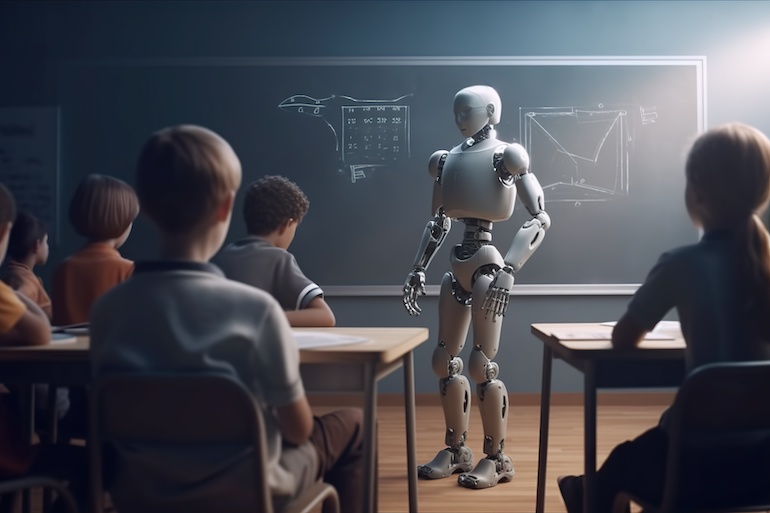
Last month, an MIT study confirmed what many educators feared: students leaning on AI tools like ChatGPT for quick answers could stunt their long-term cognitive development.
It’s a genuine concern, but also a familiar one.
We heard the same warnings when calculators arrived in maths classrooms, or when the internet replaced library catalogues and lesson plans.
Each time, there was panic. Each time, the tools stayed, not because they were flawless, but because they delivered undeniable value.
The same is true for AI. Globally, students are already using it, often more creatively and fluently than the institutions meant to teach them. The real risk isn’t the technology itself. It’s what happens if we ignore it.
While such studies are valuable in understanding the impact of AI on education, they also incidentally monger fear over change. Fortunately, in Australia, that’s not the prevailing response. Weeks before the MIT study, the Australian Department of Education released its framework for generative AI use in schools, and in doing so started to fill the policy void plaguing this topic.
Teachers too, are cautiously adopting these tools, keen to explore how they might relieve pressure and improve outcomes.
Our team at Giant Leap recently conducted a deep dive into AI’s role in education here. Speaking to educators, we found that AI is already being used to cut down on administration time.
Unknown to many parents, teachers spend hours prepping lessons, managing paper work and writing reports. While necessary, it can also diminish their time to fulfil their core function, teaching, to the best of their ability. Many teachers rightly drew the line however at letting AI take over in the classroom.
As one described to us, while AI can create an off-the-shelf lesson plan that ticks curriculum boxes, it can’t “bring it to life”.
However, this is only the start of where this trend can go.
Four decades ago, Benjamin Bloom’s research demonstrated that one-on-one tutoring can elevate student performance by two standard deviations, the so-called “Two Sigma Problem.” But personalised tutoring has always been too costly to scale.
Thoughtfully designed AI, layered with teachers’ expertise and experience, offers a path to bring tailored learning to more students, adjusting pace, feedback, and support to individual needs.
Crucially, our research found that for AI to reach its full potential in revolutionising the education system, we need to keep pushing. While the Australian Department of Education’s framework is an overdue starting point, policymakers need to work towards pushing these innovations further, supporting teachers in using AI to do more than just mop up admin work.
Investors too need to play a part. While both teachers and students are embracing AI, capital has yet to follow. Our research shows that education startups attracted just 4 percent of Australian impact investment deal volume last year.
That number isn’t just small; it’s telling. Investors remain cautious, put off by edtech’s reputation for slow sales cycles, fragmented systems, and the perennial problem of user-buyer mismatch, where teachers use the products but school leaders make the purchasing decisions.
The biggest challenge to this transition is that studies like MIT’s recent research will encourage a broader wait-and-see approach to this innovation. Education holds a totally different mentality to the startup sector.
Where one fails fast, pivots and adapts, the other is more measured, waits for tangible outcomes then, after assessing, acts. But in periods of wholesale disruption—as we see ourselves in right now—favour belongs to those who take risks and embrace change.
The MIT study highlights the risks of leaning on AI without guidance. But the greater danger lies in hesitation, when what’s needed most is support and bold action to make AI a tool that truly elevates education.
- Joanna Lee is an investment analyst at Melbourne impact investor Giant Leap.






Daily startup news and insights, delivered to your inbox.