

















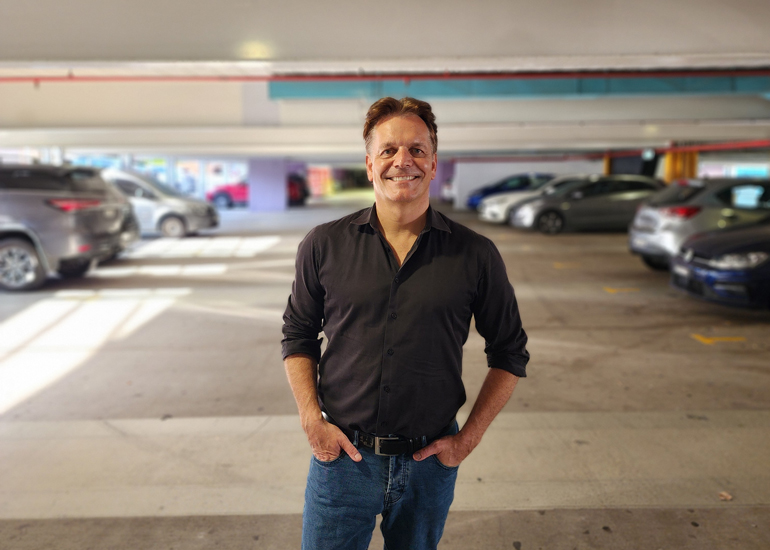

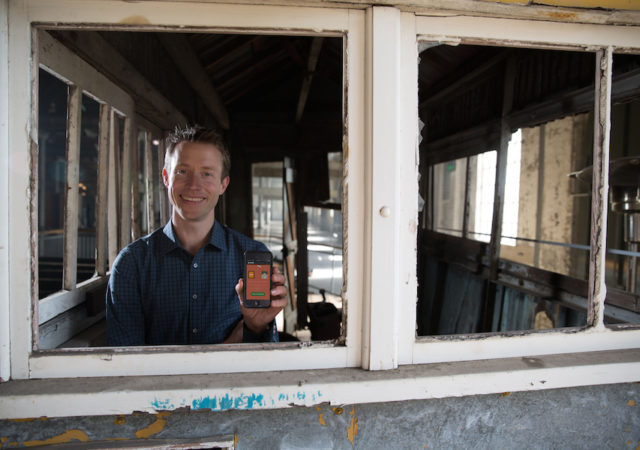
Going global from day one, Sydney-based smart parking startup KERB chose to launch in Southeast Asia. Founder Rob Brown shares how that decision thrust his business into the fast lane.
Just six weeks after launching a parking app to help Aussies rent their driveways, Brown realised the company had built the wrong product and needed to shift gears.
In 2017, after gaining some media coverage, KERB received unexpected interest from churches, hotels, and office blocks.
This feedback prompted a switch towards a different solution. “We pivoted into car parks,” Brown tells Startup Daily. “This required building a different type of software. Our breakthrough was the KERB Box, an IoT device that opens any car park barrier anywhere in the world, with the landlord’s permission.”
KERB’s technology allows organisations to monetise unused or under-used car park space in cities, as well as getting more vehicles off the streets. It gives landlords and car park operators a way to dramatically reduce the cost of running their car parks, via a unique software solution that works on top of their existing parking infrastructure.
“You no longer have to pay hundreds of thousands, if not millions, of dollars, for third-party operators to manage your car park or to install expensive, complex equipment,” explains Brown.
Now, KERB connects drivers with spaces and parking operators with drivers across the world. They have raised around US$14 million (AUD$21.8 million) in total, with the last Series A round securing US$4 million (AUD$6 million) from private investors – a testament to their successful strategy of choosing to enter Southeast Asia first.
How KERB chose their market
“The standard practice is to win the local market first, then maybe expand into the UK or US where they speak the same language,” Brown says.
Instead, Brown chose to explore the opportunities presented by Southeast Asia, especially for tech companies. In a region made up of 11 diverse countries, many with growing middle classes looking for high-quality services, Brown thought strategically about where to go first.
“[We weighed up] Malaysia versus the Philippines: one’s a very competitive market. In Malaysia there are all sorts of alternative access solutions and quite a sophisticated market too, far more akin to Singapore,” Brown explains.
“Whereas the Philippines just doesn’t have the infrastructure that Malaysia’s got or Singapore’s got and really needs. So, they’re even more motivated to fix some of these problems around congestion.”
While Malaysia seemed like the right fit, it proved challenging for KERB to monetise. Brown says it was “a great teacher for us”, and ultimately opened the doors for expansion into other Southeast Asian markets including Vietnam, the Philippines and Singapore.
“The Philippines is emerging as a market with fantastic potential for KERB,” says Brown. “Doors are opening there with major property groups faster than we’ve seen in any other market. There is clearly a gap in the market for KERB’s parking software solution.”
The tech explosion in Southeast Asia
The numbers don’t lie: Southeast Asia is poised to become the world’s fourth-largest economy by 2040 and already boasts the fourth-largest financial hub in Singapore. Projections suggest the region’s digital economy will be worth up to US$1 trillion by 2030, compared to Australia’s projected $56 billion annually by that same year.
With around half a billion digital users, including more than 100 million new users over the past three years, Southeast Asian consumers are ready for digital solutions that can change their lives at scale.
There’s a growing need for solutions in areas like cybersecurity, digital infrastructure, digital health, cleantech, fintech and AI-driven tech across sectors, representing an enormous opportunity for Australian startups.
Fast-tracking entry with Austrade
In good news for KERB and other tech businesses, there’s a groundswell of government support. The Australian Trade and Investment Commission (Austrade), the government agency promoting international trade and facilitating global connections, is actively working with scaleups to increase two-way trade and investment (a mission outlined in the Federal Government’s Southeast Asia Economic Strategy to 2040).
“Austrade has been fantastic for us,” Brown says. “Two of our major breakthroughs resulted from Austrade missions, offering introductions and meetings with key partners and officials that we couldn’t secure on our own.”
KERB took part in Austrade’s Landing Pads program, which helps export-ready Australian tech businesses to expand globally and attract international investors, through bootcamps, market advisory and more. They’ve since been on trade missions to Malaysia, Indonesia and Vietnam that have directly resulted in clients and important relationships.
“It’s really hard for a startup to get a meeting with, say, the mayor’s office or a major corporation. So Austrade is your best friend in that respect,” Brown says.
The brand’s success in Southeast Asia boosted investor confidence and facilitated access to capital. Milestones include securing a contract with Kuching International Airport and taking out the 2021 Toyota Global Smart City competition, beating more than 90 tech firms and university research departments to provide a solution for Kuala Lumpur that would provide the biggest benefit at the lowest cost to the city.
“It’s demonstrated to investors that we can go into challenging markets and prove we’re a global business and have actually got the goods,” says Brown.
In-person relationship building matters
While Austrade may make the intros, you need to be committed to building relationships yourself, says Brown.
“You’ve got to invest in the market physically. You can’t just go on an Austrade mission – Austrade really stressed this on their missions. It’s opened our eyes that this isn’t going to turn the Vietnam or Malaysian market on for you,” he says. “You’ve got to come back again and again and again. You’ve got to build up the trust. They want to see you there. They want to know you’re committed.
“Because if you think about it, it makes sense from their perspective: ‘I’m about to engage this Australian company or this Australian company’s technology solution, but I don’t know if I’ll ever see them again yet I’m going through all the work to get this approved internally’. They don’t speak the language, so you’ve already got some huge hurdles there. But investing in the market by going there is absolutely critical.”
Having a local representative on the ground also helps. “So when you come in as the founder, you go into those meetings with somebody who’s going to speak the language, do the interpretation if necessary, do the follow-up, and follow the protocols around business cards and gifts and things,” Brown says.
Other factors founders need to consider
Brown advises considering what the competitive landscape is for your tech product and if there’s a market for it.
“It might be that Singapore is an easier place to start because of the language and is similar to Australia in terms of its corporate regulations,” he says, adding that Austrade is essential in helping navigate these differences.
“Southeast Asia is like Europe in that it’s so different. It’s like comparing Greece to Ireland, or Italy to Romania – they’re completely different. And they’re different in the same way that countries across Europe differ – they have distinct languages, obviously, different cultures and socioeconomic factors, different levels of GDP.
“How much do people pay? How much are people willing to pay for your product or service, or are they willing to pay at all? Or are there free substitutes in the market? So that’s one thing to consider. Language is obviously another huge consideration.”
Don’t hesitate, go to Southeast Asia now
Brown says he would “100 per cent” recommend other Australian founders explore Southeast Asia over other regions.
“Where most companies have zigged, we’ve zagged, which means it’s probably taken a little bit longer to get to where we’ve got to today,” Brown admits. “But now, especially with our second-generation technology platform which we’ve built out of Vietnam, we’ve got the flexibility that we needed to scale this business.”
Find out more about the opportunities in Southeast Asia at Austrade’s website. If you’re keen to join a Landing Pads program in Singapore, Vietnam or Indonesia, view the current expressions of interest for programs available.
For more tools, information and support to help you grow overseas, explore the Go Global Toolkit.
This article is brought to you by Startup Daily in partnership with Austrade.
Feature image: Supplied.




Daily startup news and insights, delivered to your inbox.