
















Australia could bury its head in the sand while AI disrupts education and existing human capital – or Australia can enhance AI’s potential benefits by lifting the skills and preparedness of Australian workers and students.
Australia could squander the enormous benefits of adopting early – or it can embrace AI to help advance the government’s Future Made in Australia ambitions for a more diverse, internationally competitive manufacturing sector and a cleaner, cheaper electricity system.
Australia could be at the end of a global supply chain – or it can develop national capabilities in AI technology here at home and shape standards for responsible use around the world.
Australia could shy away from the wave of technological transformation as it sweeps across the globe – or we can embrace and shape it with confidence and purpose.
Don’t lean back
I see AI as an incredibly valuable tool for advancing our government’s broader agenda for a Future Made in Australia.
The application of this general-purpose technology will help drive innovation and direct investment toward the most productive, most value-adding and strategically important Australian industries.
Like critical minerals processing. Clean energy manufacturing. Medical technology. Sovereign industrial capabilities in defence.
Adopted properly, AI can help Australia advance its scientific and research objectives, drive decarbonisation across the economy, revitalise industry, enhance the export competitiveness of Australian manufactured goods, boost productivity and lift the living standards of all Australians.
The technology is here now, and if Australia is to make the most of it, we can’t afford to lean back.
It’s up to all of us – government, industry, civil society groups and trade unions – to lean in with purpose and a clear sense of the national interest.
This government’s National AI Capability Plan, which I’m proud to be developing, will do precisely that – leaning in, but in a way that realises opportunity for all Australians, not just some.
As I’ve said previously, that ought to include giving workers some say in how AI is integrated into their roles, and supporting them with training and skills pathways.
There is a lot of commentary about what the key principles for AI adoption might look like.
3 core principles
There are three core principles that will help Australia realise all of its possibilities and capability-building potential.
First, Australia needs to be proactive and purposeful in seizing the opportunities of AI.
That’s not just a matter of ruling out thickets of regulation that would discourage investment.
Rather, it’s crucial that Australia has its own AI capabilities and digital infrastructure – data centres, AI startups and more.
The Albanese Government’s Industry Growth Program grants are helping small and medium enterprises to grow and develop.
So far, that’s $392 million to support the growth and commercialisation of companies including innovators and startups who are bringing new AI capabilities to Australian industry.
The government has also allocated $1 billion from the National Reconstruction Fund for investment in Critical Technologies for Australia’s future.
And the Fund is already investing in companies that are applying AI innovatively for the betterment of biomedical processes, clean and efficient energy supply and Australia’s defensive capability.
Australia needs to be ready, willing and able to host the digital infrastructure that will support growing AI demand in this country, and in the wider region.
No one left behind
Second, Australia needs to commit early and sincerely to sharing the benefits of AI among everyone – not just AI firms or big corporate players, but everyone.
That’s entirely in keeping with this government’s core political philosophy: no-one held back and no-one left behind.
Roughly a month ago, Jobs and Skills Australia released an important report that discussed the likely effects of AI on the Australian labour market.
That report indicates that AI will change the kind of work Australians do and the way they go about it.
But the number of occupations at risk of disappearing is, on balance, pretty small – not zero, of course, but pretty small – while the number of occupations likely to have their functions augmented is high.
For most Australians, sharing in the benefits of AI will depend on calculated investments in their AI skills and capabilities.
For some, it will also require support and the provision of new opportunities to retrain and reskill for the jobs of the future.
The tech sector can play an important role here, working alongside government and the education sector.
The Albanese Government wants to see small and medium enterprises benefiting from AI alongside their large partners, suppliers and competitors.
That’s why we announced, in our last term, $17 million of public investment in the creation of four AI Adopt Centres.
Businesses who have engaged with these centres are already finding ways to improve the world of work and service provision – reducing intensity for some workers and improving clinical accuracy for others.
I think here of occupational therapists engaging with AI Centres to implement PatientVoice, an AI-powered platform that streamlines the administration processes so practitioners can spend more time with their patients.
I think about the work of J Robotics, an agricultural tech startup developing smart machines that use UV light instead of harsh chemicals to combat mildew’s effect on wine crops.
That means more sustainable farming and less exposure to chemicals for workers.
The government has also allocated $47 million for a Next Generation Graduate program, along with 1 million free ‘Introduction to AI’ scholarships, to help provide graduate students and other Australians with important AI competencies.
Australians should also feel the benefits of AI each time they engage with their governments.
My colleague Finance Minister Katy Gallagher is working on behalf of the Albanese Government to make sure that the Commonwealth deploys AI in the Australian public sector to improve its services, augment the jobs and skills of public servants and build the government’s capability.
Keeping AI safe
The third principle – critical for building confidence in new technology and managing risks to Australia and Australians – is that we keep Australians safe.
That is a responsibility for government – and we will be squarely focussed on building the capability to deal with risks and to act effectively to deal with bad actors and malign applications of this technology.
But it is also a shared responsibility for all of us in the sector.
Driving AI adoption starts with building Australians’ trust and confidence in the technology.
No new technology comes without the potential for risks and unintended consequences.
While that’s no excuse for shying away from the enormous opportunities of AI, I want to be clear that there’s also no excuse for neglecting our responsibilities to the Australian community.
The Albanese Government has already demonstrated that we take our share of that responsibility incredibly seriously.
In the previous term, the government criminalised the distribution of deepfake pornographic content.
This month my colleague, Anika Wells, has moved to ban deepfake pornographic and nudify apps to protect Australians – and especially Australian children – from the predations of these vile applications.
As the minister says, it’s “too important not to act”.
The work of keeping Australians safe is not confined by Australia’s shores.
There are opportunities here for Australian leaders to advance Australian interests by collaborating with likeminded partners overseas to shape global AI frameworks and standards.
Democratic AI safety
Of course, the commentary around AI policy tends to focus on government.
But as with earlier general purpose technologies, AI will pose risks that Australians need to tackle collectively and democratically.
That means schools and higher education providers helping students to use AI productively, safely and critically.
Healthcare providers being clear and transparent with their patients about the AI technologies that are assisting their treatment.
Businesses testing and refining their integration of AI technology in production and retail processes, and responding to consumer feedback.
Social media companies putting their shoulder to the wheel in the global effort to mitigate the misuse of AI on their platforms.
Generative AI companies dealing fairly and lawfully with copyright holders and the intellectual property of others.
Think tanks and civil society groups leading thoughtful, constructive conversations with the public about how AI can be used effectively and safely.
Above all, it means you, the leading voices of the tech sector, taking your responsibilities with the utmost seriousness.
Trust is a really precious commodity. It’s slow to accumulate, quick to dissipate and slower still to rebuild.
My challenge to everyone here today is to make trustworthiness a central pillar of the work you do in fostering AI uptake in Australia.
Seizing the opportunity. Sharing the benefits. Keeping Australians safe.
These are clear, fair, non-negotiable principles.
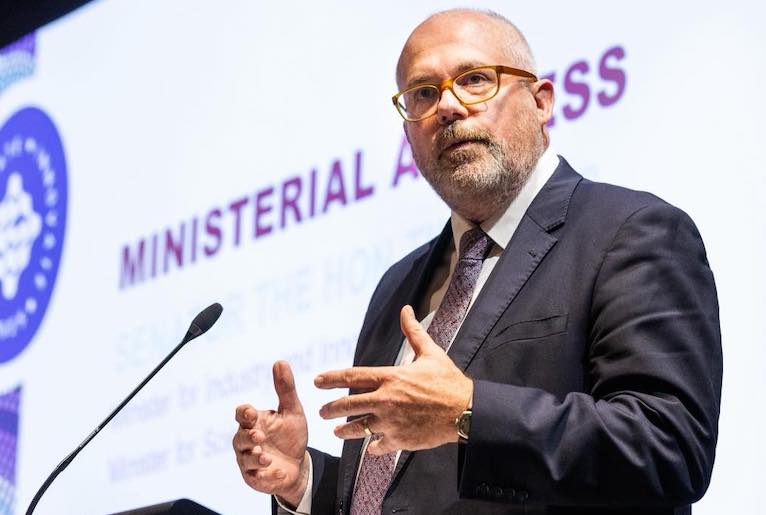
- Senator Tim Ayres is the federal minister for industry, innovation and science. This is an edited version of his address to the National Tech Summit.






Daily startup news and insights, delivered to your inbox.