


















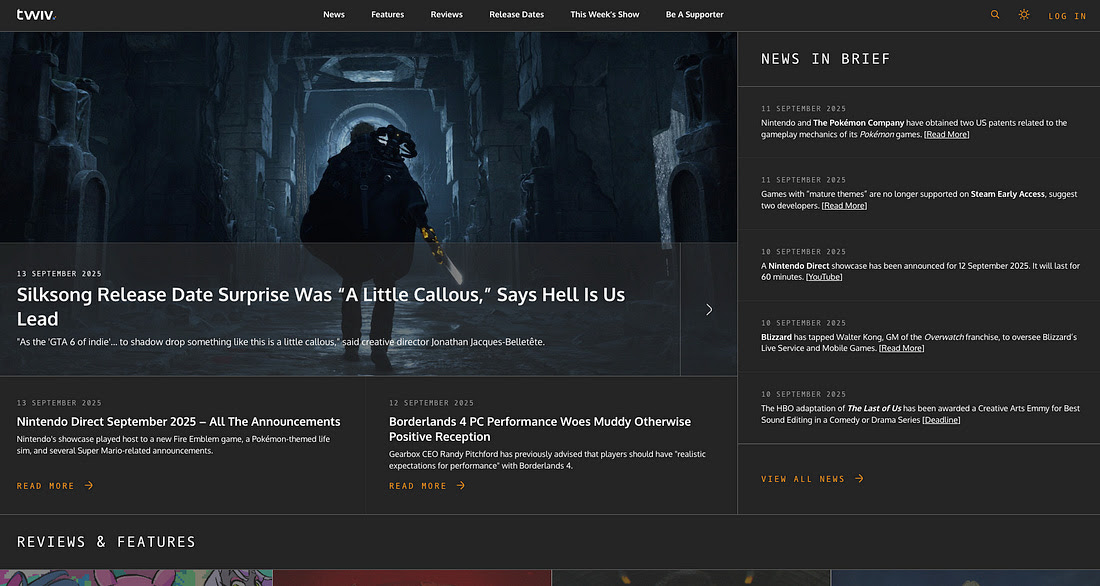
One month in and This Week In Videogames, launched by an Australian content creator, is off to a roaring start.
In an industry full of busy people, Edmond Tran has to be among the busiest.
For the past month, Tran has been working as an editorial Swiss Army knife for the new gaming news website This Week In Videogames – an initiative cooked up in partnership with major Australian gaming content creator Ralph Panebianco, better known as SkillUp. He’s supported by part-time UK-based journalist Maddie Agne to pull together what feels like an insurmountable amount of content for a tiny team on a daily basis.
The site produces roughly three to four news pieces per day, publishes several columns each week, game reviews and collates industry news across social media. The majority of the news site’s content is free. But in order to pioneer the ad-free, reader-led approach that Panebianco and Tran are aiming for, they charge a $10USD per month subscription to initially cover costs, but eventually to grow the platform.
As Tran explains to Infinite Lives, the reception so far has been overwhelmingly positive. He didn’t reveal any commercial details, but the site currently publicly lists over 550 paid supporters.
“I’m a very risk-averse person,” he says. “I was expecting the worst, especially because of the subscription model. But the reception was so positive — it really surprised us.”
“On day one, when Ralph [SkillUp] mentioned it on his This Week in Videogames show, the response was overwhelming. Our servers actually went down, which was stressful at first until we realised it wasn’t a failure — people were just flocking to the site. It felt a bit like a Silksong moment where people crashed the store.”
This Week In Videogames is one of the latest in a number of green shoots initiatives from those in the videogame media industry. Others include Rogue, which was set up this year by former Polygon staffers following the site’s acquisition by Valnet earlier this year, and Aftermath, which launched in 2023 and is run by former Kotaku US writers.
High-profile solo reporters are getting in on the action too. Stephen Totilo’s Game File continues to lead the charge in this regard on Substack. This year also saw the launch of The Game Business, run by UK games journalism veteran Christopher Dring in partnership with Geoff Keighley, pioneer of The Game Awards and Summer Game Fest.
All but The Game Business are chasing monthly subscription revenue from their readers as a primary means of monetisation, with the former instead positioning itself as an advertising platform for those looking to reach decision-makers in the gaming industry.
There is a market for reader-funded publications in the videogame space. Since launching in 2023, Aftermath has amassed 4300 paid subscribers as of last April, up 1500 in a year. It’s charging $70USD per year. In its one-year anniversary post in January, Game File reported 1079 paid subscribers out of 17,000 in total. It asks for $13USD per month.
Standing out in the crowd
Despite entering what seems like an increasingly crowded space, This Week In Videogames stands out as a unique venture on a number of counts. First, it’s one being pioneered by a creator (SkillUp) in partnership with Tran, a career games editor and journalist. SkillUp’s influence and significant YouTube audience of over 1 million subscribers has given the site a running start in drawing a crowd.
Second, it primarily runs out of Australia. While the sector feels big enough for all of its outlets, and is incredibly collegial with its players giving one another advice, This Week In Videogames‘ would-be competitors are largely US-based.
It shares a similar value proposition to most reader-funded sites: no ads, no clickbait, no affiliate deals. It’s capitalising on the malaise against all three, given their proliferation in traditional games journalism business models.
Perhaps one way in which This Week In Videogames stands out is in its ethos and design. Its website aims to be a homepage for all things gaming, where most of the valuable information sits above the fold, so users can get a bird’s-eye view of the sector at a scan. News content is written in a way that is reminiscent of a newswire; stories are short, to the point and factual.
Despite operating out of Australia, Tran and Panebianco both decided to focus the site globally from inception. That’s reflected in its subscription, which is charged in US dollars.
“Videogames are a global language,” Tran said. “They’re not inherently tied to Australia. I love Australian outlets like Checkpoint and Sifter, but their content works just as well globally.”
“It was the same at GamesHub” he added, citing one of his earlier employers. “We didn’t want to restrict ourselves with a ‘.com.au’ domain. Even when we focused on local stories, those stories were still relevant to readers around the world.”
Tran adds that being global lends itself to a greater pool of potential subscribers, but cited one complication that really limits This Week In Videogames from basing all of its editorial resources here in Australia: the tyranny of distance.
“One of the hardest things as an Australian journalist is being invited to preview a game in, say, France. Do you take a day and a half to travel for a few hours of hands-on time? It’s exciting once or twice, but it’s not sustainable. Having a global team solves that,” Tran says.
Yet, despite broadening their net, the goal isn’t a mass audience.
“We’ve built an audience that’s relatively small, but loyal. And that’s enough… A few thousand dedicated readers sustain us, and that lets us focus on what’s important,” he said.
Future plans
In a YouTube video announcing the This Week In Videogames site, Panebianco outlined its rather straightforward business plan. If just 1% of his video channel subscribers paid $10USD per month, that would create a very sustainable business, he said. If they convince up to 2%, that would allow them to scale.
“We’re definitely on our way,” Tran said. “We’ve already got enough support to think sustainably about expanding the team. That’s always been the goal. We’re very fortunate to be in this position so quickly.”
“We’re also in a position to commission freelancers now, which is something we want to do more of. There are so many talented writers out there with great insight who need places to publish. We want to be one of those outlets.”
But even with the running start from the SkillUp channel, the website’s broader goals still lie in raising overall awareness — even among those unwilling or unable to pay.
“About 85 to 90% of what we publish is open to everyone,” Tran said.
While only talking about This Week In Videogames and not the broader shift in the games media industry, he observed: “We don’t think putting everything behind a paywall helps move games media in a positive direction.”
What do you think about the shift toward paywalls across the new videogame industry news sites? And how many – if any – do you think you can support? Let me know in the comments below.
- Harrison Polites writes the Infinite Lives newsletter. Follow him here.
Sign up for his newsletter below:
- Infinite Lives is a reader-supported publication. It’s free to sign up and read the latest piece, but as of July a subscription will be required to read Harrison’s backlog of over 70 unique articles. Each subscription goes towards improving his Substack, supporting the broader Substack gaming community and funding more independent games journalism in Australia.









Daily startup news and insights, delivered to your inbox.