


















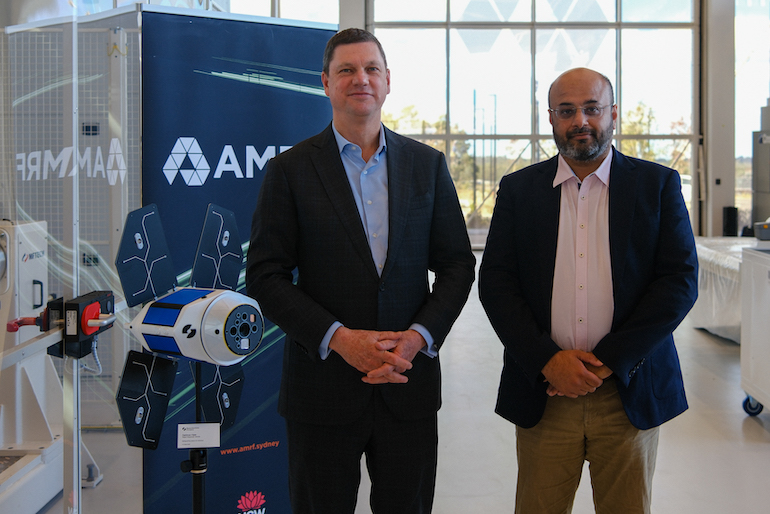
Bradfield, the site of the new Western Sydney airport, will become a manufacturing hub for space infrastructure such as satellites following a deal between the NSW government and local startup Space Machines Company.
Space Machines Company will begin high-value manufacturing projects at the Advanced Manufacturing Readiness Facility’s (AMRF) this year, developing production capability to produce satellites which are used to repair other satellites in orbit.
It’s expected the AMRF will support Space Machines Company (SMC) to initially produce more than 30 units annually, with production expected to scale up to hundreds of units per year by 2030.
The government is also exploring opportunities for SMC at Bradfield’s Second Building and looking at establishing a dedicated Hyperscale Satellite Production Facility in Bradfield City.
The agreement – dubbed Rapid Australian Production & Integration for Distributed Space (RAPID) – also prioritises the development of a shared roadmap to build sovereign space manufacturing capability, open new market opportunities, and align with the strategic objectives of both the Australian and NSW Governments.
SMC CEO Rajat Kulshrestha said Western Sydney is the ideal location to establish Australia’s sovereign space manufacturing capability.
“Through our partnership with BDA (Bradfield Development Authority) and the AMRF, we are not just building satellites – we’re creating the critical infrastructure that will safeguard space for Australia and our allies,” he said.
“Space production at scale is essential for national security in the modern era. This partnership enables us to build from tens of spacecraft annually and scale toward producing hundreds by 2030, giving Australia and allied nations the rapid response capabilities essential for protecting our critical space infrastructure.
NSW planning minister Paul Scully said the agreement will help build skills in Western Sydney, creating jobs and accelerating innovation.
“By linking global industry partners with the Advanced Manufacturing Readiness Facility, we are equipping NSW with the training, equipment and expertise needed to produce world-leading technologies,” he said.
“This partnership marks a transformative step in making Australia’s newest city a leading centre for high-tech manufacturing, workforce development, and sustainable economic growth.”
Last month, SMC announced it had finalised a 3D-printed rocket engine with 65-second-plus burn capability. The Scintilla propulsion engine has had more than 1,200 seconds of total testing time and 40 restarts. It’s designed for the company’s rapid response vehicle – Optimus Viper, designed for rapid orbital manoeuvring and space domain awareness missions.
The metal 3D-printed engine, developed by SMC’s propulsion team, delivers 50 Newtons of thrust and offers a new approach to satellite propulsion, prioritising reliability, scalability, and rapid iteration capabilities.







Daily startup news and insights, delivered to your inbox.