


















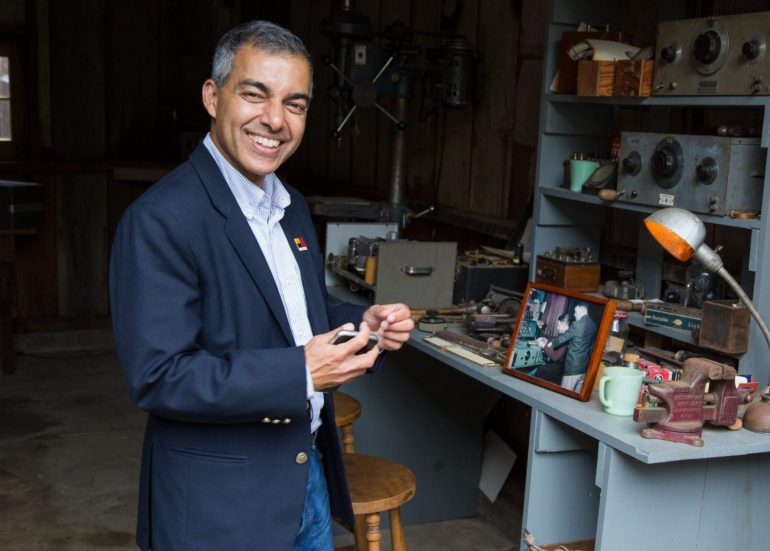
The founder of 20-year-old Canberra cybersecurity firm QuintessenceLabs, Dr Vikram Sharma, is among eight of the nation’s top scientists, innovators and educators recognised in the 2025 Prime Minister’s Prizes for Science.
The annual awards recognise outstanding achievements in scientific research, innovation, and teaching
Queensland University of Technology physicist and air quality expert professor Lidia Morawska won the $250,000 Prime Minister’s Prize for Science, and this year’s awards introduced the Prime Minister’s Prize for Aboriginal and Torres Strait Islander Knowledge Systems, awarded to professor Michael Wear,.
Dr Sharma founded QuintessenceLabs in 2005. It protects data using quantum random number generators and advanced data access control software.
Earlier this year, the company scored $15 million from the government’s flagship National Reconstruction Fund as part of a $20 million raise.
Quintessence Labs previously raised a $25 million series B in October 2021, topped up with $5 million from Chevron the following year.
The full rundown of winners is:
Prime Minister’s Prize for Science: Distinguished Professor Lidia Morawska, whose pioneering work in the study of air quality provided vital insight in the fight against the spread of COVID-19. Her work has redefined the science of air quality and reshaped policy advice to vastly improve how the world mitigates health risks of air pollution.
Prime Minister’s Prize for Innovation: Dr Vikram Sharma, recognised for translating Australian research in quantum science into world-leading cyber security solutions. In 2008, Dr Sharma founded QuintessenceLabs in Canberra, a leader in Australia’s growing national quantum industry.
Prime Minister’s Prize for Aboriginal and Torres Strait Islander Knowledge Systems: Professor Michael Wear, a Malgana Traditional Custodian of Shark Bay (Gutharraguda) in Western Australia. Prof Wear is recognised for improving ATSI peoples’ livelihoods through the respectful practice of Aboriginal knowledge systems for Sea Country conservation and sustainable commercial activities. He is the founder of Tidal Moon, Australia’s first Indigenous-owned and led sea cucumber fishery and marine restoration enterprise.
Prime Minister’s Prize for Excellence in Science Teaching in Primary Schools: Mrs Paula Taylor for transforming STEM education in ACT primary schools. She brings to the classroom innovative, real-life learning experiences that engage students of all abilities and inspire a lifelong passion for science. Taylor has worked with more than 10,000 students and 480 classroom teachers in her role at the ACT Education Directorate’s Academy of Future Skills.
Prime Minister’s Prize for Excellence in Science Teaching in Secondary Schools: Mr Matt Dodds, fors his creative teaching methods to equip students from rural areas and diverse backgrounds with the STEM knowledge and skills they need to thrive in their futures. Mr Dodds has dramatically increased the number of female students studying physics at Glen Innes High School in NSW and inspired many students into further STEM study and careers.
Malcolm McIntosh Prize for Physical Scientist of the Year: Professor Yao Zhen, for his groundbreaking work to produce clean hydrogen directly from seawater, helping to accelerate Australia’s green hydrogen industry in the transition to net zero.
Frank Fenner Prize for Life Scientist of the Year: Dr David Khour, for using applied mathematics to translate scientific research into actionable evidence. These outcomes have guided drug development for malaria and vaccine policies for COVID-19 and mpox.
Prize for New Innovators: Dr Nikhilesh Bappoo for developing novel and accessible medical technologies, including ultrasound-based technology to aid cannulation and solutions to help prevent heart disease. He is driven by his vision of a world where no life is lost because healthcare was too complex, too late or out of reach.
More on the achievements of the 2025 prize recipients is here.



Daily startup news and insights, delivered to your inbox.