

















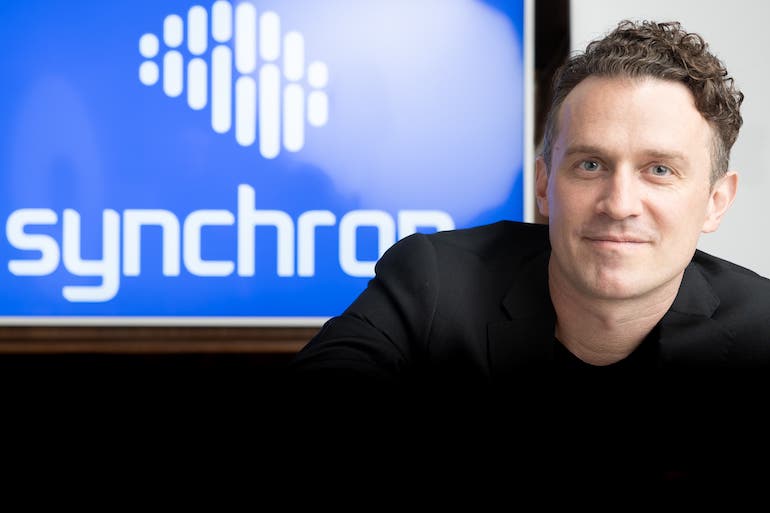
The federal government’s $15 billion National Reconstruction Fund (NRF) has invested $54 million in Australian founder Brain-Computer-Interface (BCI) medical devices company Synchron as part of a US$200 million (A$305m) Series D.
Synchron was spun out of University of Melbourne by cofounders Dr Tom Oxley, Prof Nicholas Opie, and Dr Rahul Sharma in 2012. The company is now US-based.
A collaboration with researchers from in partnership with the Royal Melbourne Hospital and the Florey Institute of Neuroscience and Mental Health, Synchron has developed the Stentrode, a BCI device that will enable severely paralysed people to control digital devices with just their thoughts. The device doesn’t require open brain surgery and instead mimics the approach used in cardiovascular stents, significantly reducing patient recovery time.
The Stentrode interfaces with the motor cortex through the blood vessels, recording and transmitting neural signals wirelessly to enable hands-free control of digital devices.
The round was led by Double Point Ventures, alongside existing investors ARCH Ventures, Khosla Ventures, Bezos Expeditions, NTI and METIS. The NRF is a new investor along with T.Rx Capital, Qatar Investment Authority (QIA), K5 Global, Protocol Labs, and IQT. Synchron has now raised US$345m in total. Jeff Bezos and Bill Gates previously backed Synchron’s A$110m Series C in 2022.
The Stentrode rivals Elon Musk’s brain implant company Neuralink in helping people translate brain activity into digital commands. Musk reportedly tried to cut a deal with Synchron back in 2022 as his own company struggled to deliver on its ambitions.
Stentrode BCIs have been placed in 10 patients with paralysis to date, across clinical trials in the US and Australia.
Synchron was the first BCI company to integrate Apple’s BCI-human interface device, having co-developed a Bluetooth-based iOS protocol that connects brain activity directly to Apple devices using Switch Control, including iPad, iPhone and Vision Pro without the need for touch, voice, or eye-tracking.
It’s the only BCI company collaborating with tech giants Apple, Nvidia, Amazon, and OpenAI.
Oxley, Synchron’s CEO, said an expanding Cognitive AI division in New York City will train models that learn from brain data to decode thought in real time, while a new engineering hub in San Diego will build the world’s most advanced brain interface.
“We’ve built the first non-surgical brain-computer interface designed for everyday life for people with paralysis,” he said.
“This funding brings us closer to commercialising the Stentrode BCI platform, while accelerating development of a major breakthrough in the field – a next-generation, transcatheter high-channel whole-brain interface.”
The NRFC’s funding will be used to conduct final clinical trials and secure US regulatory approval for the device. Synchron also plans to seek additional funding to help establish a commercial hub in Australia to support sales, marketing, and distribution functions for Australia and the Asia-Pacific region.
Double Point Ventures cofounder and MD Campbell Murray said Synchron has the ability to transform everyday healthcare.
“Its fusion of neurovascular access, breakthrough device engineering, and adaptive AI marks a fundamental step toward restoring digital agency to people with paralysis,” he said.
In a statement announcing the funding, the NRF said its $54 million “commercialises Australian innovation and technology” and hailed Synchron as “a homegrown medical sciences company that was founded at Melbourne University in Australia before making the difficult decision move overseas in search of capital.”
NOW READ: Connecting brains to computers: 3 startups, including Australia’s Synchron, that have pioneered the technology







Daily startup news and insights, delivered to your inbox.