


















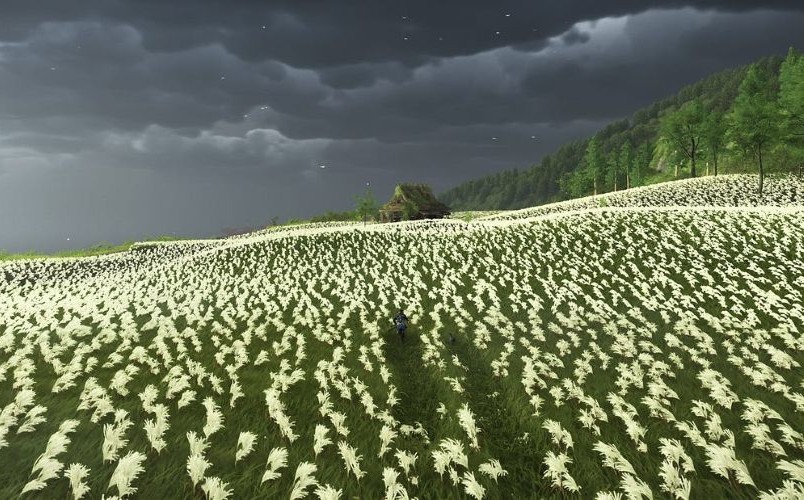
If there’s one thing PlayStation exclusives tend to nail it’s a game about revenge.
Some of the console’s greatest hits — God of War, The Last of Us Part II, even the original Ghost of Tsushima — focus squarely on this theme. In games, this generally sets up a final boss fight, and then the story more or less works backwards from there.
Given this, Ghost of Yotei shouldn’t be that remarkable. There’s a lot of other competing factors that make it easy to skip. It’s the second AAA game this year set in Edo-era Japan, with Assassin’s Creed: Shadows looming large over it. Even its launch window is smack bang in the middle of a whole bunch of other sequels, including Hades 2, The Outer Worlds 2 and of course, Hollow Knight: Silksong.
Yet, what developer Sucker Punch has produced here is by all measures a triumph that is very hard to fault. It is arguably one of the best action-adventure exploration games I’ve played in a while that crucially doesn’t overstay its welcome.
It’s also, in my view, the best and most human revenge plot PlayStation has published to date. Without spoiling either game, it feels like it’s been made for those who found themselves yelling at the TV in frustration at the end of The Last of Us Part II. The ones who thought that game should have ended about three hours earlier than it did.
You know who you are, and I’m right there with you.
Humanising “the Onryo”
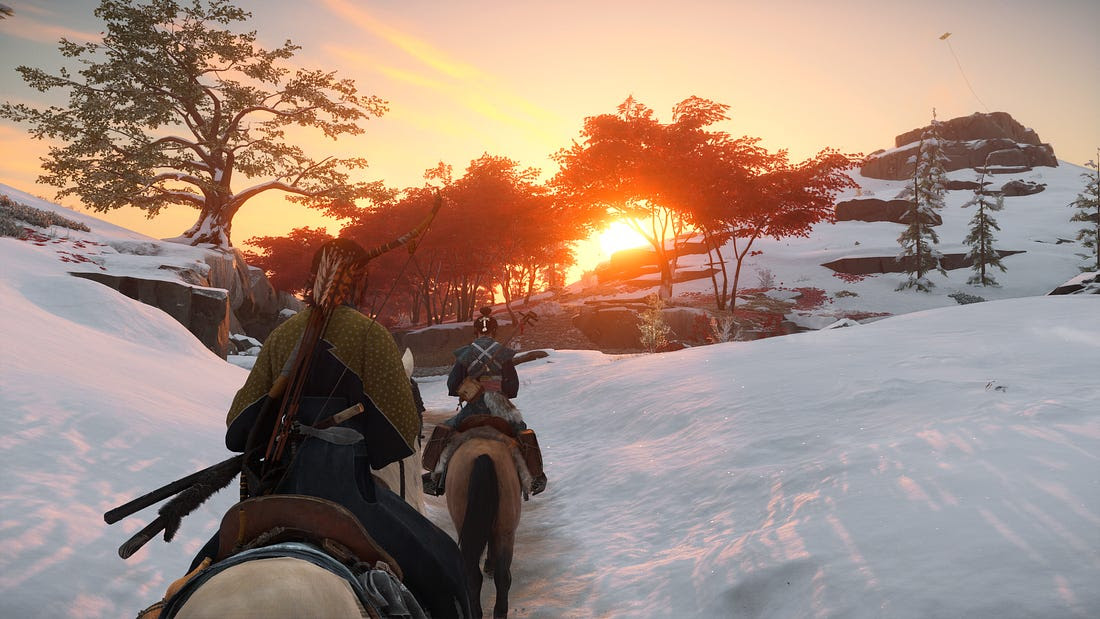
Quiet story-driven moments punctuate the action.
While building on the mechanics of the first game, Ghost of Yotei isn’t really a sequel to 2020’s Ghost of Tsushima. The game is set hundreds of years in the future, on the northern Japanese island of Hokkaido with an unrelated plot.
The protagonist of the game, Atsu, is the sole survivor of a massacre of her family on their farmstead by the now-notorious Yotei Six. She flees to the south, trains for over a decade in the way of the warrior, and returns as an adult ready to exact her revenge. It sets up a compelling ‘Kill Bill’ style of story, where Atsu proceeds by crossing names off her list. Your first few minutes of the game are spent painting them onto a sash.
What makes this quest for vengeance so unique is the humanity that Atsu shows as she works to complete her goal. She’s initially presented as a one-dimensional character, dubbed “the Onryo”, a spirit whose sole goal is vengeance. As the game progresses, her reputation as this spectre of hatred grows, yet her journey challenges her resolve. She learns to accept, love and eventually, even forgive.
While the main plot beats aren’t too surprising for this kind of story, it’s ultimately their delivery that cements their meaning. These moments, poignantly voice-acted and paced to not overwhelm the player, add so much colour and emotion to the title. It defies what could have easily been a ‘kill them and be done with it’ style of game — the kind of nuance we’d expect from a book, maybe a movie, but not really a videogame.
Restraint-enabled success
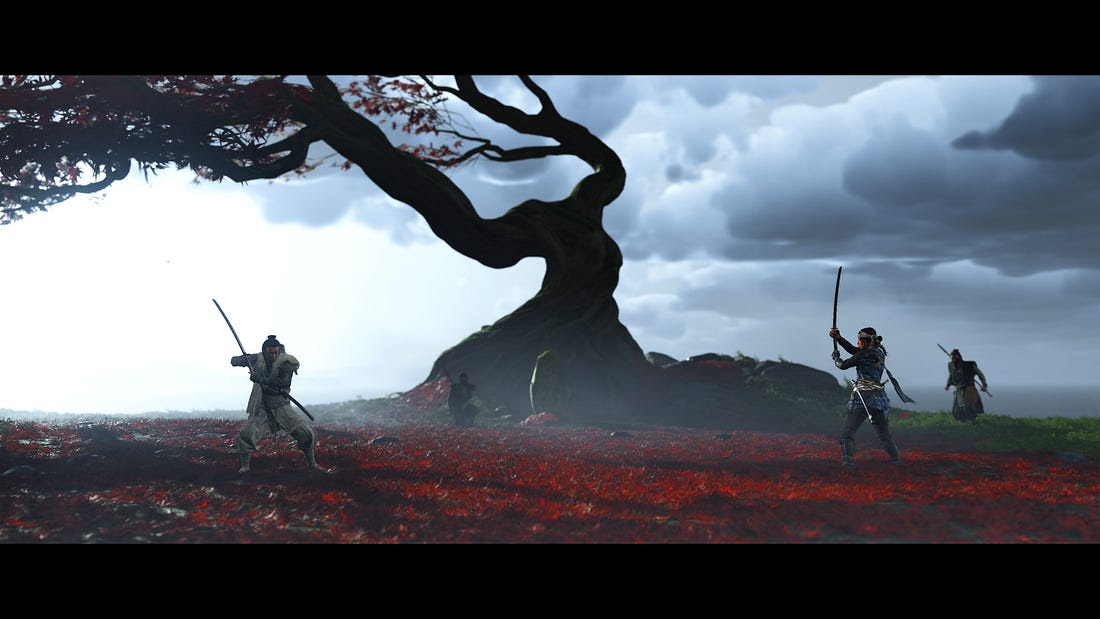
One of the many iconic duels throughout the game.
Given the timing of the games, comparisons here can’t be helped between Ghost of Yotei and Assassin’s Creed: Shadows. Perhaps the foundational point separating the two is restraint. By pairing all of its mechanics back, menus and user interface, Ghost of Yotei actually accomplishes more than its rival.
That all starts with map design. The frictionless gameplay we saw in the original Ghost of Tsushima makes a clear return, and is very much improved. It’s very easy to flow from one activity to the next in Yotei. You can boot up the game, wander and stumble on meaningful things to do. The guidance system, in the form of wind that helps guide you to your objectives, and golden birds that direct the player to nearby points of interest, greatly assist.
Building on this, the game focuses on density of objectives, rather than the size of its world. You can ride from one end of Ghost of Yotei’s main area to the other in under 10 minutes. But along the way, you’d stumble across over a dozen activities and points of interest. One quest also tends to feed into another too. As a result, it’s easy to just melt into a rhythm with Yotei, going from point to point, playing at your own pace and dipping into the story when that exploration loop gets stale. That feels like the most enjoyable way to play this game.
Tiny changes make all the difference here. In a departure from the original, the entire map is displayed upon booting up the game. It’s a relief more than anything. The surprise ‘second island’ of the first title is a key churn point for that game, especially if you aim to do everything the first island has to offer before proceeding.
Another small thing: activities are broadly not revealed on the map until you discover them. It alleviates the laundry-list feeling that you need to undertake every task in order to play the game properly; a common gripe with longer open-world games. Completing a task also unlocks fast travel to that point on the map. As one would expect with a PS5 exclusive, it’s near-instant, showing off the promised hardware capabilities of the device.
Combat also feels as seamless as navigation in Ghost of Yotei. It’s not complicated, initially containing three buttons and a parry system. Through adding in additional weapons, tools and gear, over time it becomes more sophisticated. Enemies eventually start to outnumber you and vary up their tactics too upping the difficulty.
Duels, however, take it all to another level. These solo fights, primarily with bounty hunts or bosses, are tense moments of gameplay that take the same combat mechanics and kick them into overdrive. Most boil down to learning timings for parries and when to press the advantage. They are also gorgeously framed like a piece of stylistic old Japanese cinema, with Atsu staring down each opponent, sword drawn. Each one feels handcrafted and unique, with each enemy throwing a new combo or trick into the mix. Without spoiling anything, some later duels are absolute standouts of the entire game.
For those hoping for a quieter approach, stealth is in the game, and it is possible to focus on it over outright combat. But it’s not a standout. In many instances it feels way more satisfying to charge enemy camps than take them out by range or quietly. There’s missions that require it, but Yotei is not reinventing the wheel here. It’s nothing we haven’t seen before. But that’s OK. It doesn’t get in the way of the overall experience.
And in fairness, if there is one aspect that Assassin’s Creed: Shadows has over Ghost of Yotei, it lies in parkour and climbing mechanics. Atsu just looks a bit clunky as she scrambles up ropes, leaps to ledges or navigates natural obstacle courses. It’s my only fault in what is a fairly faultless package. Again, they aren’t bad here, the mechanics and animations are just stronger in Shadows. But it’s hardly a qualifying reason for marking down this game.
Standing up to its price tag
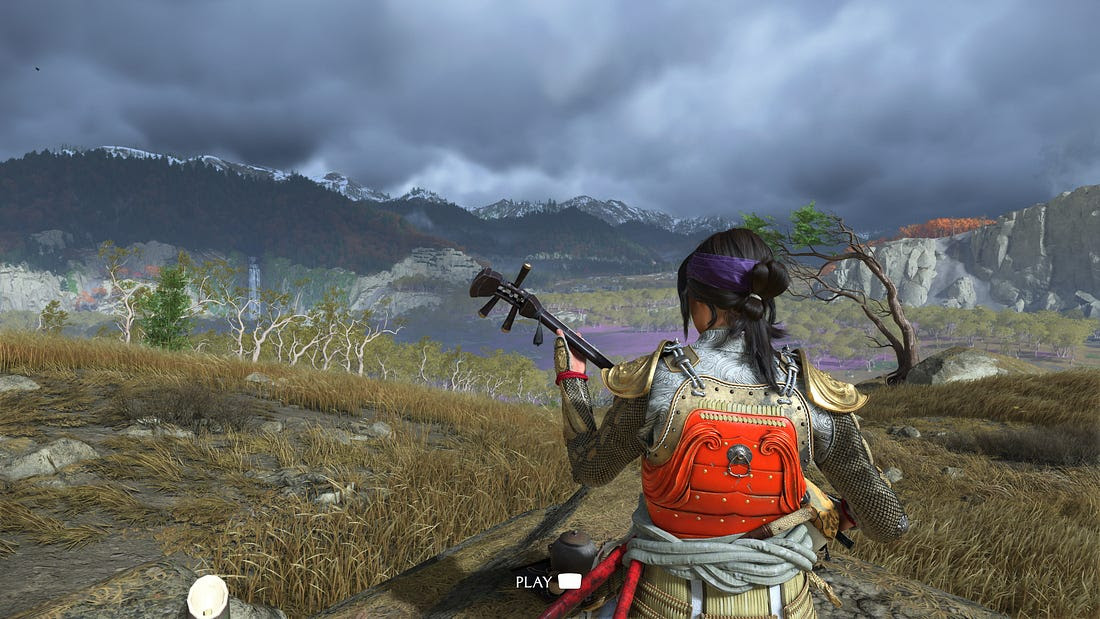
A lot of effort has gone into making the landscape vibrant, but not unrealistic.
Aesthetically, Ghost of Yotei is perhaps up there as one of the best-looking PlayStation 5 games around. Bright colours punctuate what could have been very monochrome plains, snowfields and coastal plateaus. They add a sense of whimsy and mythology to the landscape. Yet while superstitions play a role in the game’s overall story, despite its landscape design this is not a game that leans heavily into the supernatural.
Similar vibrancy is seen with the game’s soundtrack, primarily punctuated and led by the Japanese instrument the shamisen—Atsu also plays this at various points on her journey. It’s designed to elevate the experience as opposed to distract from it, and given the game’s striking visuals I think this is the right call so as not to give the player sensory overload.
The overall look and feel of the game is important, as Ghost of Yotei is priced at a premium, retailing for $125 AUD. And I believe, unlike a lot of other ‘premium’ PlayStation games I’ve played in the past 12 months, it actually justifies its hefty price tag. This title pushes gaming as a genre forward in a positive direction.
Beelining the story, you are looking at around 15 hours of gameplay, but I doubt anyone but speedrunners will play it this way. It’s just too easy to get lost exploring and spend well over 40 hours seeing all there is to see. At no point does it become exhausting or unsatisfying. Smooth fast-travel mechanics also raise the value of each minute spent in this game. Yotei players spend more time in the action and less moving from one point on the map to the other.
Reading all of this, you are likely thinking that Ghost of Yotei doesn’t really bring anything groundbreaking or new to the table. And you would be right. This may go some way to explaining why it didn’t muster up a nomination for Game of the Year at The Game Awards.
Despite distancing itself from the original narratively, this is a sequel in the truest sense. If you like the original, you will like this game. Yotei perfects mechanics from Tsushima, adds in ideas that may have been left on the cutting room floor and greatly streamlines others.
But in an era where AAA games are perhaps getting too ambitious, too big, too bloated—while an ageing gaming population gets more conservative with its time—this is not only fine, it’s perhaps a path forward. Just because the hardware permits games that are larger than life, doesn’t mean it should be so.
It’s a genuine disappointment that this game may miss out on further acclaim, largely because it launched in a year of standout titles. For those with a PS5, it is well worth your time. In my view, it genuinely has been snubbed. But if the game itself is any frame of reference, there’s only one path forward for its maker, Sucker Punch.
Revenge.
Reviewed on: Playstation 5 Pro
Worth playing if you like: Ghost of Tsushima, Horizon: Forbidden West, The Legend of Zelda: Tears of The Kingdom.
Available on: Playstation 5, Playstation 5 Pro. Releasing on PC at a later date.
- Harrison Polites writes the Infinite Lives newsletter. Follow him here.
Sign up for his newsletter below:
- Infinite Lives is a reader-supported publication. It’s free to sign up and read the latest piece, but as of July a subscription will be required to read Harrison’s backlog of over 80 unique articles. Each subscription goes towards improving his Substack, supporting the broader Substack gaming community and funding more independent games journalism in Australia.






Daily startup news and insights, delivered to your inbox.