


















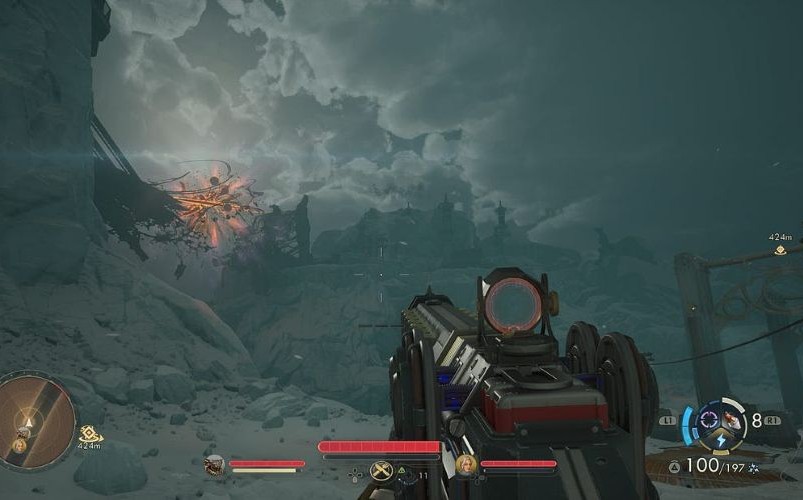
It’s one of the most absurd ways to end a videogame. In the original The Outer Worlds, the fastest way to finish is to fly a spaceship into the sun.
To do this, you need to create a low-intelligence character, and then when prompted insist that you personally – instead of an AI – will do the maths required for a complex space jump on a derelict spaceship.
The ship’s computer chimes in: “Does your captain seriously intend to do a micro jump in-system with engines that haven’t been powered in 70 years? On a derelict ship?”
Your AI replies: “That’s what my captain intends, yes.”
It’s an outlandish moment that nails the tone of The Outer Worlds games. It’s borderline iconic for those who’ve seen it, and speaks to the game’s overall goal of giving the player agency over the story. And quietly, it’s perhaps a bit of a dig at other role-playing games that give the player so much choice but end in the same way. Or in the case of the Mass Effect trilogy, with a different Instagram filter over the final cutscene.
Three months since release and players are yet to find an equivalent in The Outer Worlds 2. While there’s a chance it may exist, I strongly suspect it does not. As a result, regardless of any and all decisions you make in the game, every path leads to one confrontation. The one speech check. The one boss fight.
While there’s a lot to love about the sequel, and a lot that has been refined from the original, I didn’t feel the need to play again and see the path less travelled. And for this type of game, that’s the best indicator of quality.
While I hate to coin a phrase here, I also can’t help but feel like The Outer Worlds 2 has been “game pass-ified”. It’s the third title I’ve played this year from a Microsoft-owned studio that was good, but just short of being excellent.
Capitalists, scientists and autocrats
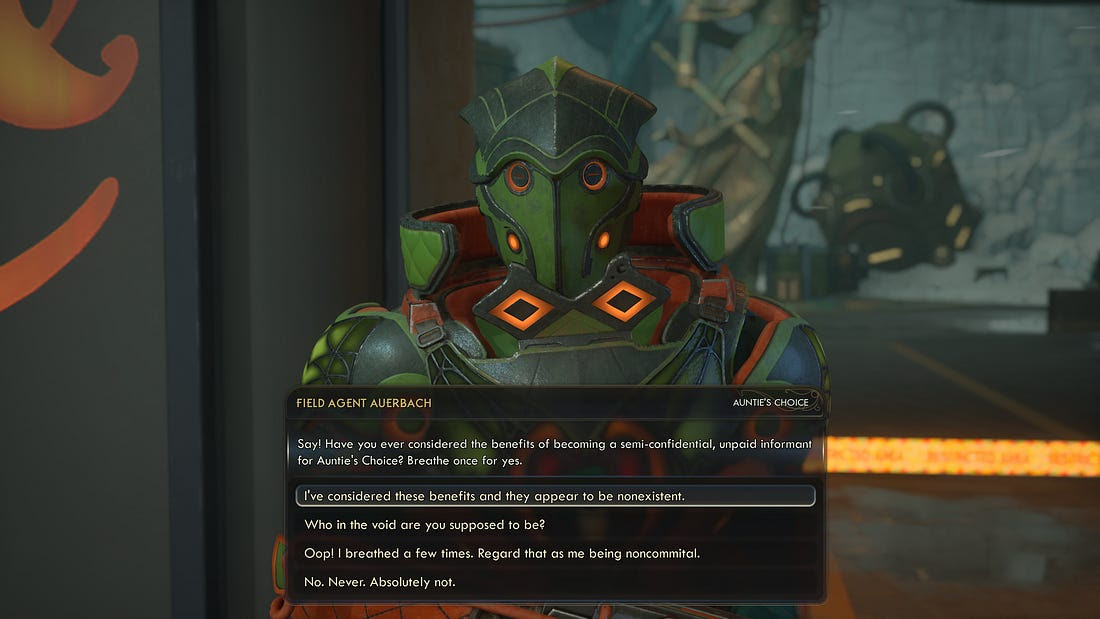
So much effort has gone into putting a decent joke or quip into just about every line of dialogue.
Set in the brand-new Arcadia System, The Outer Worlds 2 is a direct sequel that has little to do with the original game and is easily playable without the context of its predecessor. The closest comparison here is the Fallout series, but for those without that frame of reference, it’s a cross between a shooter and a role-playing game, borrowing elements from both.
You play as a ship captain in the Earth Directorate, tasked with procuring unique technology being developed by the autocratic regime, the Protectorate. The mission goes sideways, creating tears in space known as rifts that grow to threaten life in all of Arcadia, potentially the universe.
One convenient time skip later, and you are tasked with saving the system by dealing with the rifts through any means necessary. Aside from its exotic environs, the Arcadia System is defined by its three main factions.
Aunty’s Choice, a hyper-capitalistic corporation that cares more about its bottom line above all else -the result of a merger between Auntie Cleo and Spacer’s Choice from the previous game.
The Order, a society focused on science that believes maths can predict the future and determine all outcomes. Sounds familiar? They are very similar to The Foundation from the book and TV series of the same name.
And the aforementioned Protectorate, a regime that explores the idea of serfdom in space. A monarchy that uses brainwashing (AKA “mental refreshment”) to tame the population and keep them compliant.
It’s a great set-up, expanding on the critique of capitalism from the last game to look at the pros and cons of other unique philosophies. It’s a title that will make you think, without feeling like a second-year Arts degree.
Navigating the game relies on you playing these factions off against one another. How you do that comes down to dialogue choices, which are dictated by your character’s stats and abilities. Provided you can’t talk your way out of a situation, you can shoot your way out too.
Combat is a key part of the game, and it’s improved on the original. There’s a greater diversity of weapons and ways to take on any situation the game throws at you. There are plenty more tools at the player’s disposal than in the first game to skew the odds, like an energy shield that protects you from bullets, or a device that slows down time.
This all helps you level up, which in turn allows you to unlock new abilities and bolster your stats. You’ll also meet and recruit companions to help you, but more on that a little later.
What helps The Outer Worlds 2 stand out
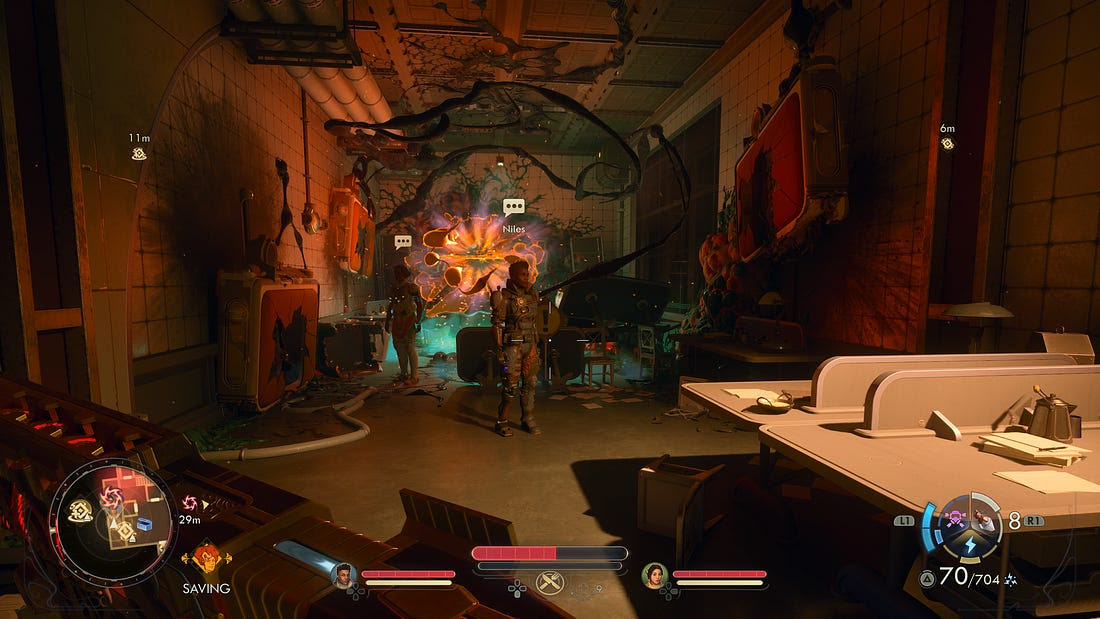
Your companions are useful, most of the time.
There are a few key differences between The Outer Worlds 2 and other games in this genre. First off, once you make a decision with upgrading your character, you are locked into it. There are no respec capabilities in this game. This creates an interesting sense of permanence with every choice, possibly aimed at encouraging multiple playthroughs. It’s a cool concept, and one that adds an extra level of pressure to each levelling decision.
But here’s the wrinkle: this title gradually punishes fence-sitters, without telling you that’s the case.
If you create a general character that tries to be good at everything, enemies get harder to defeat and you’ll eventually fail a lot of important speech checks too. Your goal should be to maximise a couple of stats and unlock a few key perks. But there’s no clear direction to do this outside of guides online.
Building on this, on occasion you’ll be presented with flaws that you can choose to add to your character. These give you a unique bonus in exchange for a detriment. For instance, if you crouch a lot, you’ll get the option to unlock a perk that makes you move significantly faster while crouched, but your knees will pop and alert nearby enemies each time you do so. They are entirely optional, and the game even discourages you from taking a few more extreme examples if it’s your first playthrough, but again, it’s an interesting variation.
Companions are pretty stock-standard for these games too. But in a departure from many other titles in the genre, there’s no option to romance any of them. The game was quick to advertise this in its launch trailers. Your own sensibilities really determine whether that’s an issue. For me, it’s no big deal.
But it perhaps hints at why many of your eventual crew mates are fairly one-dimensional. They all have an arc with their character quests, but it’s hard to build any real attachment to any of them.
This is unusual for this series. For context, this is coming from the same developer who, in the original game, had the gumption to write in a deliberately asexual companion, Parvati Holcomb, as your first crew mate. Then give her a romance arc where she finds love with another character while navigating her own aversion to physical intimacy. As such, the choice to not push the bar even further with unique side characters this time around is confusing at best.
And finally, with regards to speech checks, the game also shows you unavailable options in each dialogue tree. A small but meaningful change, again to encourage you to play through again and see what you could do with a character with different stats or who learned new information ahead of that conversation.
You may be sensing a theme here: this game wants you to play it more than once. Which feeds into my ultimate criticism of it: why would I invest another 50 hours into a second playthrough if it always broadly plays out the same way?
Strong scenario writing supports a weaker story
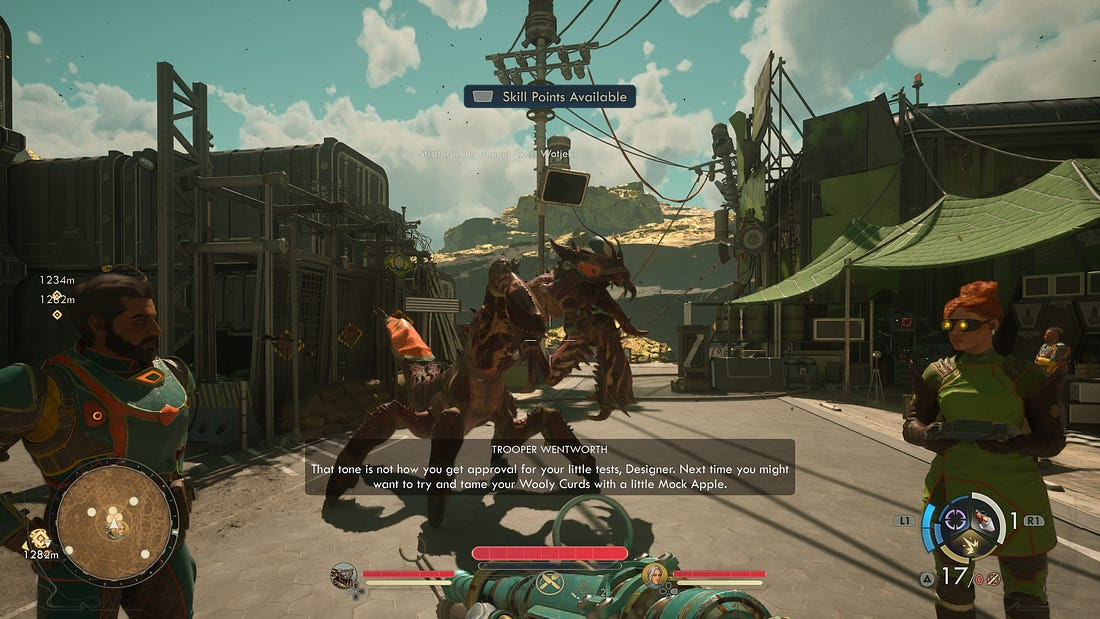
Who’s in line for a promotion? This thing.
This all ties back to the writing powering the game. There are plenty of memorable lines and zinging dialogue. All of which is brilliantly voice-acted. Some scenarios absolutely stand out.
One mission has you decide the fate of an Aunty’s Choice base that’s led by a domesticated Mantisaur – a praying mantis-style alien. One enhanced soldier is pretending he can interpret its thoughts using a grafted alien antenna — all to climb the corporate leadership ladder.
As early as the first area of the game, you can turn in one of your companions to the Protectorate in return for access to a new area, leading to a very grim, but equally surprising cutscene.
Much like an improv troupe, the game says “yes, and” to you the player, more than it says “no”. In a lot of micro-instances, you have a lot of choice and agency.
Yet, more broadly, the story writing is somewhat flat and binary. As it progresses, you basically choose between siding with Aunty’s Choice, the Order, or forcing them into an unholy alliance. Don’t forget, this is the same developer who created Fallout: New Vegas – a game made over a decade ago that offered four major faction endings, including the option to tell all of them to get stuffed and rule Vegas yourself.
Despite creating so much lore around them, the Protectorate are firmly placed as the big bad of this game. After the first area, no matter what you do, they will almost always shoot first, ask questions later. I’m not going to defend autocratic regimes, especially ones that rely on brainwashing to control their citizens. But there’s a lot of juice in exploring these ideas in a pun-tastic way that just isn’t squeezed. It’s the same reason Fallout: New Vegas let you side with Caesar’s Legion, a faction that conquered the wasteland taking on its denizens as slaves. It’s morally bankrupt, but the game still explores why in times of crisis, people veer towards this style of leadership. The Outer Worlds 2 unmasks the Protectorate a bit, but never lets you fully understand its logic or motivations.
Despite leaving some niche content unexplored across my hours with the game, the technical performance deserves mention. The game ran very smoothly on my PlayStation 5 Pro – aside from one area with a persistent audio glitch – and for games of this scope and genre, that level of stability is genuinely rare. Though I wish some work went into reducing the number of loading screens between planets and zones, that was an absolute killer with some quests that require you to visit over three planets.
Yet, despite showing so much promise in its first dozen hours, the game somehow feels slightly underdone. There are better shooters out there. There are better role-playing games too.
But if you are craving a space opera, The Outer Worlds 2 is worth a look. As a Game Pass title, it’s a steal, but a tougher ask as a $110 AUD-priced game.
It’s funny. There’s some level of irony here. The original Outer Worlds was set up as a pointed satire of capitalism. Its sequel jabs at this too, albeit in a reduced way.
I can’t help but wonder what it would look like if it was made independently of Microsoft and its Game Pass strategy – where a constant supply of decent-but-not-exceptional quality games are needed to fuel its offering.
With The Outer Worlds 2, capitalism, it seems, had the last laugh.
Reviewed on: Playstation 5 Pro
Worth playing if you like: Fallout 4, Kingdom Come: Deliverance 2.
Available on: PlayStation 5, Xbox Series X and Series S, GeForce Now, Xbox Cloud Gaming, Microsoft Windows.
- Harrison Polites writes the Infinite Lives newsletter. Follow him here.
Sign up for his newsletter below:
- Infinite Lives is a reader-supported publication. It’s free to sign up and read the latest piece, but as of July a subscription will be required to read Harrison’s backlog of over 80 unique articles. Each subscription goes towards improving his Substack, supporting the broader Substack gaming community and funding more independent games journalism in Australia.






Daily startup news and insights, delivered to your inbox.