
















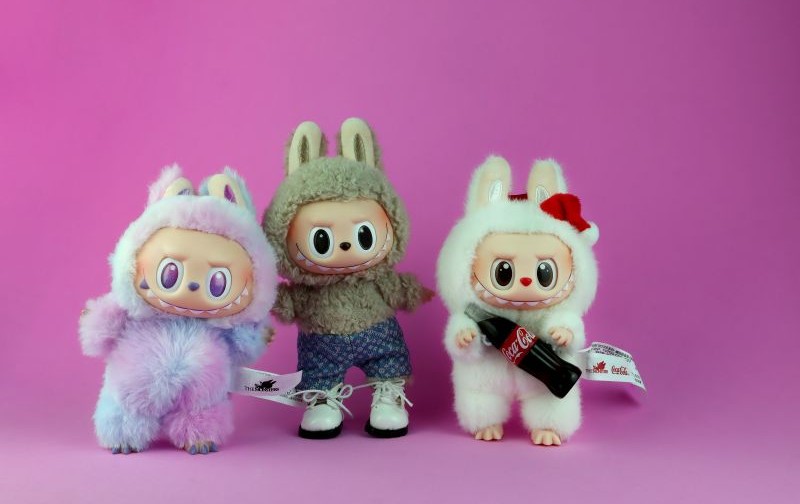
If you haven’t met Labubu yet, you’re missing the blueprint for the next wave of consumer brand virality.
Born from Hong Kong’s Pop Mart, Labubu is an oddly adorable toy that’s more than merch. It’s a cultural phenomenon.
Labubu is triggering global sellouts, fuelling resale frenzies and building a fanbase with near-religious devotion. Fans camp out for new releases. TikTok is flooded with unboxings and trades. Resellers flip rare pieces for thousands of dollars. This isn’t just fandom. It’s cult commerce at its finest, catapulting founder and CEO Wang Ning’s net worth $1.6 billion in a single day.
But this isn’t about toys.
It’s about strategy. An intentional, repeatable way to build a brand that doesn’t just grab attention – it creates a world people want to come back to, again and again.
If you’re building a commerce brand, this is the playbook for turning products into moments, customers into a community and a brand into a movement.
Because the most powerful brands don’t sell. They invite people into something bigger.
Here’s how Labubu did it:
1. Creating brand moments by riding existing waves
Labubu didn’t invent the wave, it joined the pendants and bag‑charm trend and turned it into its own emotional ecosystem. When celebrities like Blackpink’s Lisa and Rihanna showcase a blind‑box figure dangling from their bags, the impact explodes driving instant sell-outs.
That’s the lesson: You don’t have to invent the wave. You just have to ride it differently.
Take the current micro-trend of mini pendants on handbags, phones, and keychains. Now imagine a founder launching a tiny, collectible wellness mascot, a charm that doubles as a lip balm, a mantra, or a daily affirmation. Cute, collectible, emotionally sticky and layered with Labubu’s mystery-drop model you have a viral formula:
Steal what’s already working. Add narrative. Make it personal.
2. Building a brand world – not just a brand
Labubu’s magic isn’t the figurine – it’s the universe around it. From blind‑box drops to character evolution, community trades and TikTok unboxings (#Labubu has millions of views), it functions as a portal into a shared cultural space.
What makes it work:
- Storytelling: Characters, stories, and evolution over time.
- It has community rituals: Trades, fandom, TikTok reveals.
- It has texture: Emotional resonance, physical scarcity, digital spectacle.
Lifestyle brand founders can do the same whether it’s a skincare line, a wellness product, or a fashion drop – any vertical can replicate this:
- Launch product lines as chapters in a bigger narrative.
- Introduce characters, meaning, recurring rituals.
- Build interactive forums, events, or collectives where fans live the brand.
- Give customers reasons to come back not just for the product, but for the feeling.
3. Knowing the formula: Scarcity + story = brand momentum
Labubu isn’t simply purchased – it’s pursued. It’s not about clicking “buy now”; it’s about earning access, being part of a moment and owning something that not everyone can.
Think mystery boxes. Limited drops. Randomised unboxings.
These aren’t just gimmicks, they’re emotional accelerants. And when paired with compelling storytelling, they unlock $7,000+ resale prices, app-topping launches, global queues and a kind of brand devotion money can’t buy.
Why it works:
- FOMO becomes community fuel: People don’t just want the product – they want to be in on the moment.
- Scarcity becomes status: Who got the rare drop? Who shared it first? Suddenly your brand becomes a badge.
- The hunt becomes the marketing: Anticipation, speculation, unboxings – your customers generate the buzz.
Apply this:
You don’t need massive inventory. You need intention.
- Drop a limited-run capsule only to your top customers or community first.
- Embed a surprise element – a golden ticket, a rare variant, a co-created design.
- Wrap it in meaning: Tell the story of why this moment matters and why they should care. Because in today’s world, the most powerful brands don’t just sell. They stage experiences people want to be part of.
4. Not just building hype, but homes
Virality is seductive. But it’s also dangerous.
One-hit wonders burn fast and fade faster and in today’s attention economy, hype without depth is a short-lived game. Here’s where 99 per cent of viral brands fail, they chase a moment but don’t build staying power.
Labubu dodged this. It could have been just another TikTok trend – a flash of dopamine and done.
Instead, it’s building: expanding into jewellery, forums, artist collaborations, functional products and storytelling arcs that keep fans emotionally invested.
5. Knowing the danger of one-hit fame
Trends fade fast. Brands that survive build ecosystems: narrative arcs, brand alliances, owned communities, cross-category evolution.
That’s the real lesson: Cult brands don’t chase moments – they create ecosystems.
This is how you turn virality into longevity:
- Narrative expansion: Don’t just drop products, build chapters. Create storylines, character arcs.
- Cultural partnerships: Align with artists, streetwear designers, niche communities that reinforce your values and aesthetic.
- Owned community: Don’t let your audience live on borrowed land. Build spaces digital or physical where your customers feel like they belong.
- Product evolution: Extend your brand beyond its core think crossovers, limited-run merch, and adjacent categories that deepen the experience.
As a founder, you’re not just launching a product – you’re architecting a brand world.
Ask yourself:
- What spin-offs would my customers fight to own?
- Who would be the dream collab that feels unexpected but perfect?
- What would my most loyal customer want to see next, not because they need it, but because they love the world I’ve created?
Because hype can get you noticed. But homes, brands that feel like creative, connected spaces keep people coming back. Build a brand your customers never want to leave.
What you should steal?
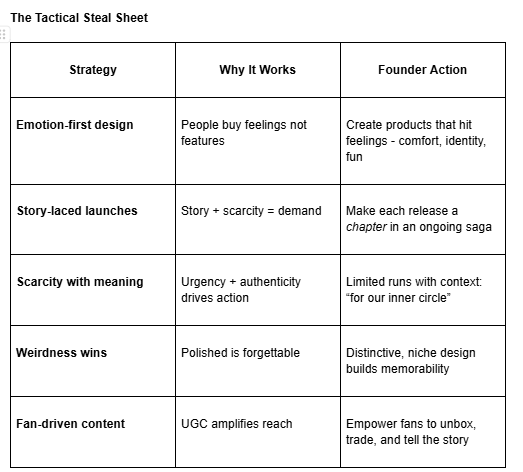
Here’s the Labubu playbook broken down into real, repeatable tactics for women building brands today:
- Design for emotional meaning, not just functionality. Your product should solve a feeling – not just a problem.
- Layer your launch strategy with storytelling. Make every drop feel like a moment in a larger story. Give people a reason to come back.
- Use scarcity to amplify narrative – not replace it. Hype alone burns out. Meaning keeps people coming back.
- Don’t smooth the edges. Embrace what makes you unique. Labubu’s weirdness is what created its magic. Be boldly niche.
- Make your customer the content engine. Labubu fans are the brand’s best marketers. Give your audience tools, rituals, and reasons to co-create with you.
Proof: Real numbers, real returns
The success of brands that have had a similar strategy in the toy market is eye boggling:
- Pop Mart’s “The Monsters” franchise (Labubu’s umbrella line) pulled in ¥3.04 billion (US$419m) in 2024, up 726% YoY.
- The global collectibles market hit $294 bn in 2023 and is expected to grow to $422 bn by 2030 .
- The toy collectibles segment alone is forecast to jump from $12.5bn (2021) to $35.3bn by 2032 .
- Squishmallows sold 400 million units as of mid‑2024, with TikTok engagement surpassing 13 billion views .
- Sonny Angel figures -$10 originals, $250 resale hit $5m revenue in late 2024 .
These are not anomalies – they are evidence. Brands that combine scarcity, emotion, community, and strategy create real capital.
Create worlds. Spark movements
Labubu isn’t quirky fluff – it’s strategic mastery. It shows how trend-savvy brand builders can cultivate emotional resonance, convert scarcity into connection and build universes people choose to inhabit.
For founders ready to break the mould: don’t ask “What should I launch?”
Ask: What universe am I inviting my customer to live in?
- Tracey Warren is CEO & Bree Kirkham, COO, of venture capital firm F5 Collective.





Daily startup news and insights, delivered to your inbox.