



















Nintendo can remotely disable Switch 2 consoles for modding or piracy, potentially challenging Australian consumer protection laws.
A month out from the console launch, and players around the world are still finding new and exciting things about the Switch 2 console. But for some users, particularly those in gaming’s more technical communities, they’re discovering Nintendo’s new enforcement policy.
As first reported on Substack by Game File, the legal agreement accompanying Nintendo’s new console — its terms of service — includes some significant new clauses. Breaking new ground in the way technology companies police how users interact with their devices, the agreement states that Nintendo has the ability to disable a Switch 2 console or services tied to it if it detects tampering or inappropriate use.
In this case, that largely means modding (modifying the console’s software or hardware), altering the console or datamining its games.
But as experts told Infinite Lives, this issue goes beyond piracy or even hacking games for cheat codes or an advantage. It wades into murkier territory like game history preservation, accessibility, and consumer rights in the digital age. It’s a complicated topic, so let’s break it down.
What’s a Terms of Service (ToS) agreement?
Anyone who’s used any form of technology over the past few years has likely signed plenty of these documents, possibly without realising.
Terms of service forms outline the legal framework supporting a piece of software or technology and how they are intended to be used. They also spell out your rights as a user of the product and the conditions under which you are able to use it.
As the Australian Competition and Consumer Commission (ACCC) pointed out in a report last month, most users — especially those in a gaming context — do not read these agreements before signing them.
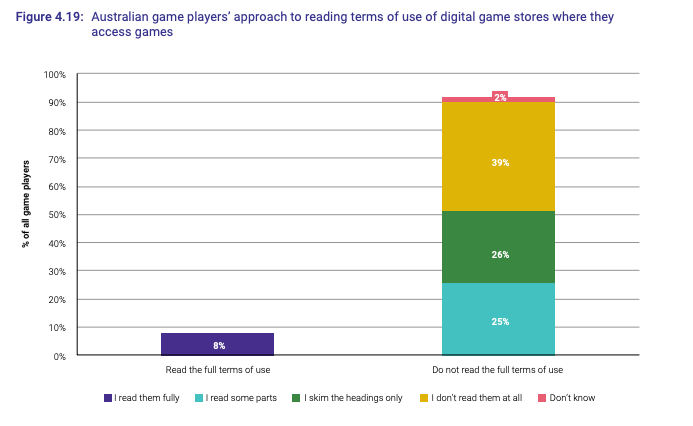
Not reading the terms of service? You are not alone. Source: ACCC Digital Platform Services Inquiry report.
Not reading the terms of service? You are not alone. Source: ACCC Digital Platform Services Inquiry report.
While we’re yet to see this play out in a gaming context, terms of service blindness and some clever legal work from companies has led to curious circumstances in other industries. For instance, Disney+’s terms of service famously smuggled in a clause which forced anyone legally pursuing the company into arbitration — a form of dispute resolution — rather than court.
Why would Nintendo do this with their ToS?
For a family-friendly company, Nintendo actually has a long history of legally pursuing companies that either infringe its intellectual property or enable others to do so. Its last prominent case in Australia was back in 2010, when it successfully sued a local distributor of the R4 mod chip.
Intellectual property and technology lawyer for Thomson Geer, Briar Francis, says that this shift in its terms of service agreement is best seen as an anti-piracy measure, aimed at curbing the circulation of illegal copies of their games.
“This tactic by Nintendo puts the pirates to one side, and shifts the focus on consumers of pirated content,” Francis says.
“It’s probably a clever move because you’re not going to convince pirates to stop, but if you’ve paid $700 for your Switch, you might think twice about modding or downloading pirated content and losing access to your device.”
She adds that in Australia there isn’t any “cheap and cheerful” traditional legal remedy for IP infringement, meaning any case from Nintendo would typically need to be taken to the Federal Court — a potentially costly endeavour.
“It’s definitely more of a problem with games sold at a higher price point — obviously, the more inaccessible a game is, the bigger the demand for a pirated copy.”
“Selling ‘cracked’ software like popular games and industry staples, such as engineering, estimating software and Photoshop, can be lucrative.”
What do digital rights groups think of this news?
They’re unsurprisingly not happy with the move. However, they argue this goes beyond simple IP protection, and branches into some murkier territory.
America’s Electronic Frontiers Foundation special adviser Cory Doctorow said Nintendo’s new terms of service actively punishes efforts to preserve video game history or hack games to make them more accessible for those with a disability. Two issues where Nintendo has historically lagged behind its competitors.
“This isn’t about protecting honest players from cheaters — it’s about protecting Nintendo’s shareholders from any legal conduct that they would prefer you not get up to,” Doctorow said.
John Pane, chair of Electronic Frontiers Australia, said the new policy challenges the notion of consumer ownership.
“EFA holds strong concerns where hardware manufacturers dictate the use of devices long after they have been sold, impacting repairability, customisation, and even the ability to use legally purchased software,” he said.
“While intellectual property protection is important, it must not come at the cost of undermining the foundational principles of privacy, security, consumer protection and device ownership.”
“Without transparency in the detection methods and a robust and responsive system for user recourse, such actions are arbitrary and punitive, leaving users with no avenue to defend themselves or retrieve their purchased content and services. There should be protections against this practice under Australian Consumer Protection law.”
Could this be challenged legally in Australia?
If there was any country where this could be successfully challenged, it could be right here in Australia.
We have a track record of busting overreaching terms and conditions peddled by video game companies. The ACCC won a case against Valve over its no-refund policy in 2017, and as a result the company has now adjusted its stance on this globally.
In this instance however, the regulator is holding its cards close to its chest. In response to questions from Infinite Lives, the ACCC provided a broader response with the guarantees and protections offered by Australian Consumer Law.
“Manufacturers of consumer electronics may have certain terms in their user agreements regarding protections to prevent the misuse of their manufactured devices,” an ACCC spokesperson said.
“However, those terms can only provide the manufacturers with rights that are reasonably necessary to protect their legitimate interests. If this is not the case, they risk contravening the unfair contract terms (UCT) prohibition.”
“Whether there is any breach of the ACL in any particular instance will depend on all the circumstances involved.”
Thomson Geer’s Briar Francis offered a more granular answer. She’s not aware of any legal precedent identical to these circumstances, so the matter would need to be settled by a court.”While it’s been around since 2019, changes to the UCT regime came into effect in 2023 which vastly expanded its scope, so we’re still testing the limits of this rule.”
“In circumstances where Nintendo can render an entire console effectively inoperable as the result of a single pirated game, Nintendo would say that the clause protects its legitimate interests in enforcing its IP rights.”
“But when the purchase of the console itself was above-board, I think there’s an argument to be had that it would be more reasonable to only allow Nintendo to render the pirated game itself inoperable on the Switch 2,” she says.
“This could be a different story where a user has committed multiple instances of piracy, in which case it might be considered more reasonable to ‘kill’ the console entirely. I imagine this is why the TOS enables Nintendo to render the Nintendo Account Services or the device itself permanently unusable in whole or in part. Nintendo has afforded itself some flexibility, there.”
The implications of Nintendo’s new terms of service extend far beyond simple piracy prevention. As digital rights advocates argue, this shift represents a fundamental challenge to consumer ownership rights in the digital age — one that could set a precedent for how other technology companies police user behaviour.
What do you think about Nintendo’s new terms of service? Is it overreaching? Is it a reasonable way for them to stamp out piracy, which costs them millions to police? Let me know in the comments.
- Harrison Polites writes the Infinite Lives newsletter. Follow him here.
Sign up for his newsletter below:
- Infinite Lives is a reader-supported publication. It’s free to sign up and read the latest piece, but as of July a subscription will be required to read Harrison’s backlog of over 70 unique articles. Each subscription goes towards improving his Substack, supporting the broader Substack gaming community and funding more independent games journalism in Australia.




Daily startup news and insights, delivered to your inbox.