



















Operating for 20 years, Australia Plays has become a globally influential gaming survey authority. But it now faces new challenges as its data matures.
Bond University’s Professor Jeffrey Brand is calm, collected and ready to go.
There’s no sense of nervousness or trepidation on a media call discussing his research into Australia’s gaming population. He deftly navigates his findings, pointing out the key figures and, crucially, its red herrings.
His tone takes a noticeable shift when he gets to the diversity findings, which plainly point out that, according to this study, more women in Australia are playing videogames than men.
“This is where one kind of falls off their seat when they see a change in the data. And this time, we saw a change in the data,” Brand says.
“I don’t want to make too much of it,” he adds, preempting the headlines.
“For me to be responsible and acknowledge the ups and downs of statistics, because it is within the margin of error, our sample not reflecting perfect reality.”
It’s not Professor Brand’s first time navigating the nuances of media on one of these calls. Far from it.
Australia Plays, a biennial report into Australia’s gaming population, has been running for two decades, with Professor Brand at its helm the entire time.
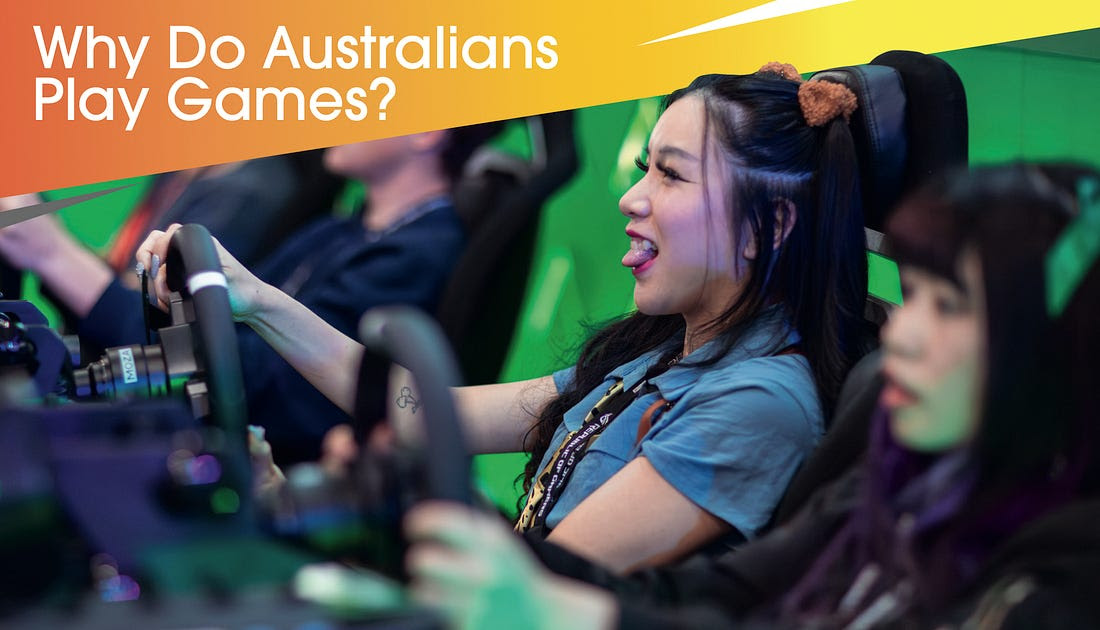
You can’t fault Australia Play’s report’s knack for choosing interesting action shots of people gaming. Source: Australia Plays 2025.
From myth-busting to agenda setting
The study surveys over 1000 households, capturing approximately 2500 individuals in total, with candidates stratified to be representative of Australian demographics.
It’s a broad piece of research, asking about gaming habits, types of games played, and why they game. This data is then broken down by age and gender, presenting a granular look at the makeup and motivations of Australia’s gaming population.
As Brand explains, it started as an exercise to prove that Australia’s gaming population extends far beyond the stereotype of being dominated by teenage boys. It’s since morphed into a report which both shapes policy and informs research globally. It also proved to be instrumental evidence in the gaming industry’s successful bid to establish an Australian R18+ rating for videogames a decade ago.
The Interactive Gaming and Entertainment Association (IGEA), Australia’s peak body for the video game industry, has backed the report since its inception. Its CEO, Ron Curry, says Australia Plays is globally the longest-running report of its kind. Other peak bodies in other jurisdictions have turned to it for inspiration for their own similar studies, and it also informs IGEA’s broader policy efforts, he adds.
“Today, when we talk to the government about child safety and access, we can point to the fact that 81% of gamers are over 18,” Curry says. “That shifts the tone of the conversation completely.”
“We’ve normalised gaming. When we began [in 2005], gamers were the minority. Now it’s those who don’t play who are the exception,” he says.
The deep, long-running partnership between Bond University and IGEA on the report has prompted past questions from media regarding the validity of the data. A similar point was raised in passing by this column two months ago.
When asked, Professor Brand addressed it head-on.
“Research needs to stand on its own, but it also needs funding,” he said. “When the government commissions research, it’s typically to guide regulation or public policy. That’s an interest too.”
“Yes, IGEA wants to promote the value of videogames. But IGEA has also been incredibly open in letting us design the study independently.”
“We select the topics, do the sampling, and use a high-end panel company, Qualtrics, to manage data collection. So even that’s at arm’s length. They don’t touch it.”
“We’re upfront that this is self-reported attitudinal and behavioural data. It’s not making theoretical claims. But it establishes a baseline that other journalists, academics and policymakers can build on. That’s the value.”
The future of Australia Plays
Producing such a long-running report has its challenges. Effort goes into maintaining the headline data: the number of Australians that game, the size and shape of Australia’s gaming population, and other strata on how they engage with the medium. All of this tells a compelling story over time.
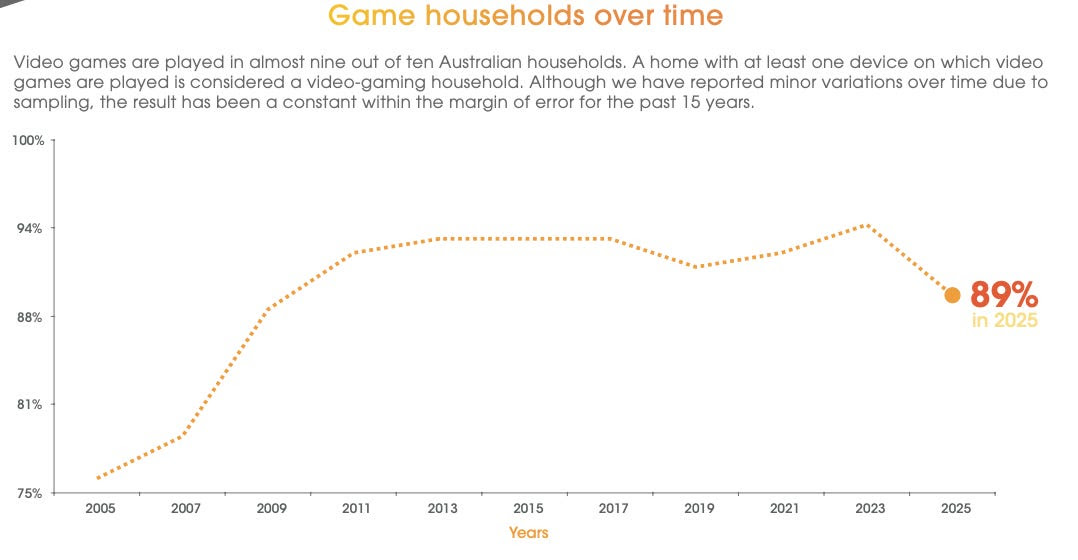
The number of Australians who game has remained consistently high for years. Source: Australia Plays 2025.
But more recently, the data hasn’t increased or changed that much from year to year, placing more focus on the specialist areas the report delves into. This iteration focused on parental play and how a generation of teenage gamers when the report started are now sharing their hobby with their kids.
“Ten years ago, the focus was on internet connectivity,” Curry says, referring to an era when the National Broadband Network rollout was a major technology issue in Australia.
“Ten years before that, it was how people purchased their games — on disc, on console, or elsewhere. As the industry evolves, so will the report.”
“For example, if platforms like Roblox take 10% of the market, we’ll need to adapt the questions we ask. The report has to mature, but it will also keep its core questions so we can track long-term trends.”
Brand says the ageing gamer population will yield its own challenges that will need to be tracked.
“Australia’s population is ageing fast. Our data shows older adults tend to play alone more than socially,” he says. “That’s a public policy opportunity. And as the medium itself evolves, we’ll have more questions to ask.”
“That’s the point of research, after all.”
The key findings from this year’s Australia Plays study:
- 82% of all Australians play videogames. The average age of gamers in Australia is 35.
- Australia is a console-dominated market, with 74% of Australian households owning at least one gaming device. Consoles are the most popular, followed by smartphones, then PCs.
- 51% of the gaming population in Australia identify as women, 1% identify as non-binary, and 48% identify as men. (Though as Professor Brand points out this result is within the margin of error, which sits at 2.7%)
- 89% of parents play videogames with their children as a means of connection. Meanwhile, 75% of parents have rules in place with their children around gameplay. Though, only half of the adults surveyed said they were familiar with Australia’s videogame classifications.
- 77% of Australians play games socially with others. The majority play to have fun (97%), destress and relax (95%) and to pass the time (95%).
- The most popular game genre in Australia is action/adventure, followed by puzzle games and then shooters and closely tied with sports games. Education /training games were the least popular.
What do you think about the findings of this year’s Australia Plays study? How important is it to track the demographics of gamers? Let me know in the comments below.
- Harrison Polites writes the Infinite Lives newsletter. Follow him here.
Sign up for his newsletter below:
- Infinite Lives is a reader-supported publication. It’s free to sign up and read the latest piece, but as of July a subscription will be required to read Harrison’s backlog of over 70 unique articles. Each subscription goes towards improving his Substack, supporting the broader Substack gaming community and funding more independent games journalism in Australia.









Daily startup news and insights, delivered to your inbox.