


















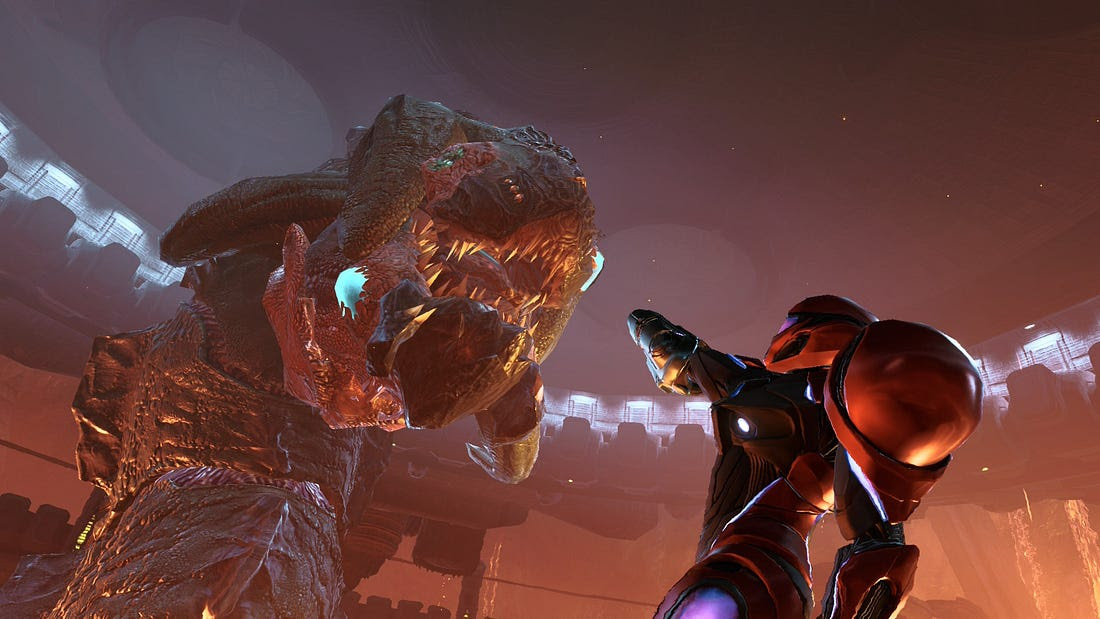
To say that expectations were high for Metroid Prime 4: Beyond may be the biggest understatement of gaming in 2025.
The title went through arguably one of the most tortuous, protracted development processes ever seen with a videogame.
Originally allocated to developer Bandai Namco, Nintendo scrapped their full build of the game in 2019, and handed it back to the developer of the original Metroid Prime, Retro Studios. Their track record spoke for itself. In the intervening time, Retro took on the Donkey Kong series, reviving the 2D platformer series across two incredible games.
After getting the go-ahead, Retro then proceeded to remake the original Metroid Prime, released in 2002, as a training exercise for the new game. But news of the new title was scarce. Metroid fans collectively held their breath.
Now, almost two decades after the release of Metroid Prime 3: Corruption, we finally have a sequel. But, as a fan of the original trilogy, which in turn pulled me into trying other retro Metroid games, it crushes me immensely to say: It’s not great.
Metroid Prime 4: Beyond forgoes so many of the conventions set by the original trilogy. It introduces a lot of new ideas, but doesn’t stick the landing. In some crucial ways, this isn’t a metroidvania game but rather a corridor shooter with extra steps. There are, of course, some merits to this game, and some fantastic ideas to boot. I’ll get into those too.
But as a Metroid fan, this is not the review I was hoping or expecting to pen.
Marrying the game Retro wanted to build, with the one they had to build
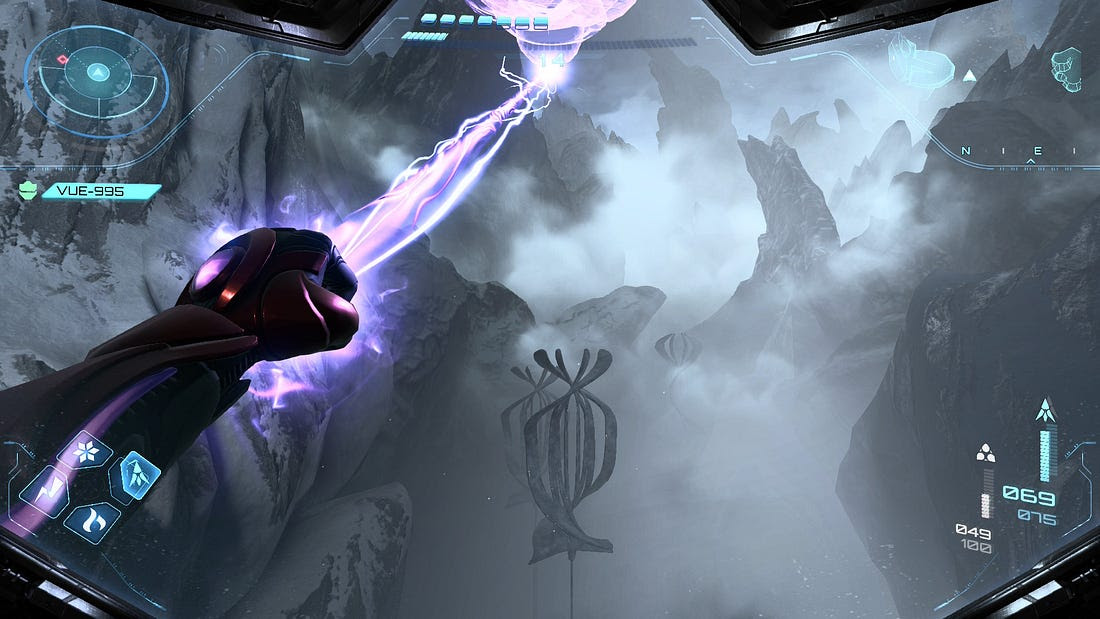
A Nintendo game that rivals the fidelity of Playstation 5 titles.
Set after the events of Corruption, Samus Aran responds to a distress call at a Federation base. It’s under attack by the Space Pirates, and it’s the woman in power-armour’s job to set things right.
It’s a fairly standard set-up, only here’s the thing: It takes a harsh left turn 20 minutes into the game. Out of nowhere, Samus is teleported to an unknown planet, given a crystal that unlocks her latent psychic abilities, and told by a hologram of a long lost psychic-powered species, the Lamorn, to find five teleporter keys to unlock the portal home, saving their legacy in the process. She is, quite literally, their chosen one.
Retro is treading a fine line. The developer wants to tell a story that’s unique to the Metroid universe, and harks back to the original game. Yet, has been tasked with creating a sequel within the existing canon. The hard pivot here seems like a strange reconciliation of these ideas, where they both keep the existing story moving but also attempt to wipe the slate clean.
For those familiar with the past games, it progresses as you’d expect. Samus loses all of her suit’s powerups as part of the warping process. You progress, finding newer psychic-enhanced versions of them, unlocking new areas as you explore. The first part of the game is fairly linear, considering it also serves as a tutorial. But here’s the thing: this doesn’t really change.
There’s a few key components to “metroidvanias” — a portmanteau of Metroid and Castlevania, two 90s games that define this genre. They are known to have intricate maps, unlockable abilities, and backtracking. Part of the joy of these games is navigation, unlocking shortcuts and gradually seeing how the map clicks together. Discovering secret passages, surpassing previously impassable areas, often being rewarded for doing so.
To this point: I’ve spent hours musing at routes through the original Metroid Prime’s Tallon IV map, pondering what is the most effective way to get from the far edges of the frozen Phendrana Drifts through to the darkest corners of the Phazon Mines. Musing whether new abilities or powerups could change my route or unlock new options. The genre’s best titles actually give you multiple ways to access new areas, bringing with them a real sense of discovery and exploration.
Beyond’s map ignores these principles. While you will occasionally be forced to backtrack to various regions, they are largely self-contained, linear and require very little navigational prowess. They also only connect to a central desert area, and they don’t link to one another in any way. It’s a massive missed opportunity, that I’d sadly say disqualifies this title as a true metroidvania game.
Part of the reason for this is the introduction of the Vi-O-La, a sci-fi motorcycle that Samus uses to cross the vast desert separating the regions. It’s a cool concept on paper, but in practice it bogs down the game’s flow. It creates a clunky additional tutorial section four hours in, and beyond this doesn’t lend much to the overall gameplay aside from a few cool cutscenes.
The fundamentals are here
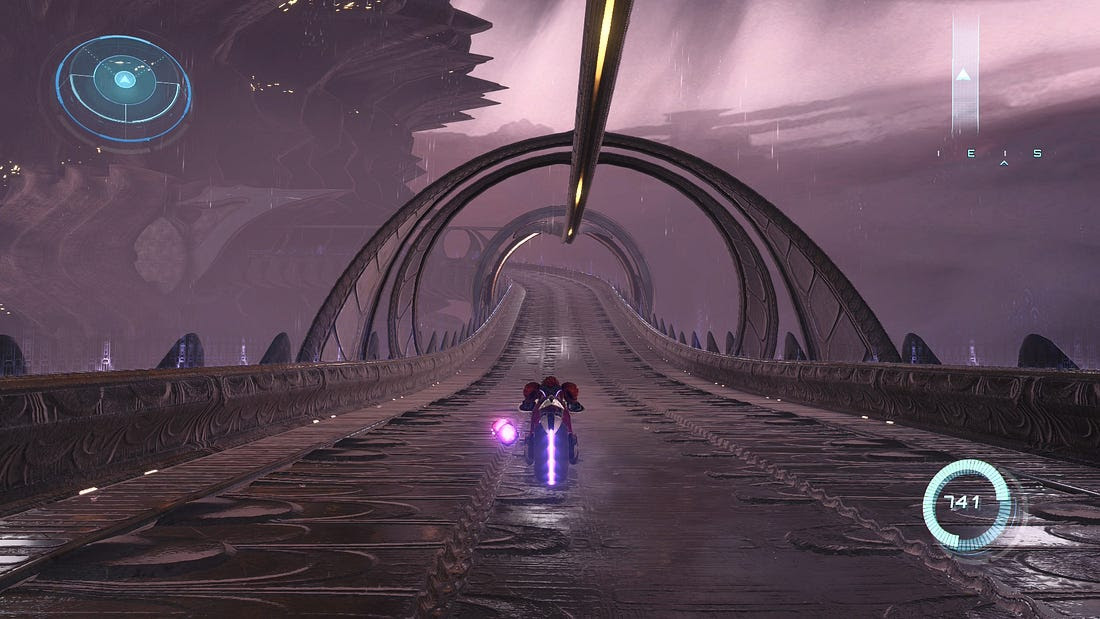
Driving between the towers of The Volt Forge.
Speaking of gameplay, while Beyond has lost its metroidvania soul, mechanically, it is still a good shooter for the Switch 2. The moment to moment gameplay here is crisp and engaging. The game also runs incredibly well at a steady 120 frames per second while docked, and 60 frames per second while handheld. It’s a consistency that’s nearly unheard of on Nintendo consoles, showing off the added muscle of the Switch 2.
The atmosphere here is also spot on. The music, sound effects and environmental design are on par, if not exceed the prior games. Much of the game is spent combing the sci-fi ruins of the Lamorn civilisation, understanding their downfall. The thunder-bound Volt Forge is a standout location in the game, where Samus navigates obstacles in the form of a Vi-O-La factory production line, all while rocking out to a cool, sci-fi inspired, heavy metal theme.
New beam and weapon upgrades leverage the best mechanics of Samus’ arsenal from the first two Metroid Prime games. A new addition is the psychic beam, in which you can control a single shot from Samus to hit a target around corners or through obstacles. It’s a neat power up that’s used sparingly in environmental puzzles, but is often more effective against certain bosses or enemies. On that, enemies tend to feel tanky until you vary up your tactics and attack them with the right weapon or ability – a nice balance in itself.
Though, it’s a shame there isn’t more enemy diversity, another hallmark of the first three games. The same robots and mutant monsters feel trotted out at every turn, albeit with slight changes to their colour palette, and abilities.
Scanning makes a return too. This is where Samus uses her suit to survey the environment and provide full articles on enemy weaknesses and clues on how to progress. This is a staple for the Metroid Prime games, and a mechanic that hasn’t readily been replicated in other titles — perhaps hinting at just how hard it is to implement.
The strength of these mechanics flows into boss fights, which again, are well designed and are standout moments of this game. Most require you to scan, pinpoint a weakness, then use your arsenal to counter them. Chip away a portion of their life, and they’ll swap up their tactics, increasing the difficulty as they go.
Many require puzzle solving, quick reflexes and pinpoint accuracy to surpass. Metroid Prime games are as much about dodging as they are about shooting, and that’s what makes them such engaging shooters. In this instance, the bosses are a masterclass of significant foes that aren’t just bullet sponges, a typical weakness of the shooter genre.
The difficulty curves nicely too. Later game bosses pose a significant and rewarding challenge, with some surprises to boot. One near-end-game boss weaves in an incredibly memorable jump scare that really subverts the player’s expectation. I won’t spoil it, but let’s just say it was particularly terrifying for me given I was on the brink of death when it happened.
Again, the fundamentals are here. Retro’s brilliance as a developer does, on occasion, shine through. But we’re yet to discuss what I’d argue is perhaps the biggest mark the game has against it: The Federation.
Chekhov’s spaceship troopers
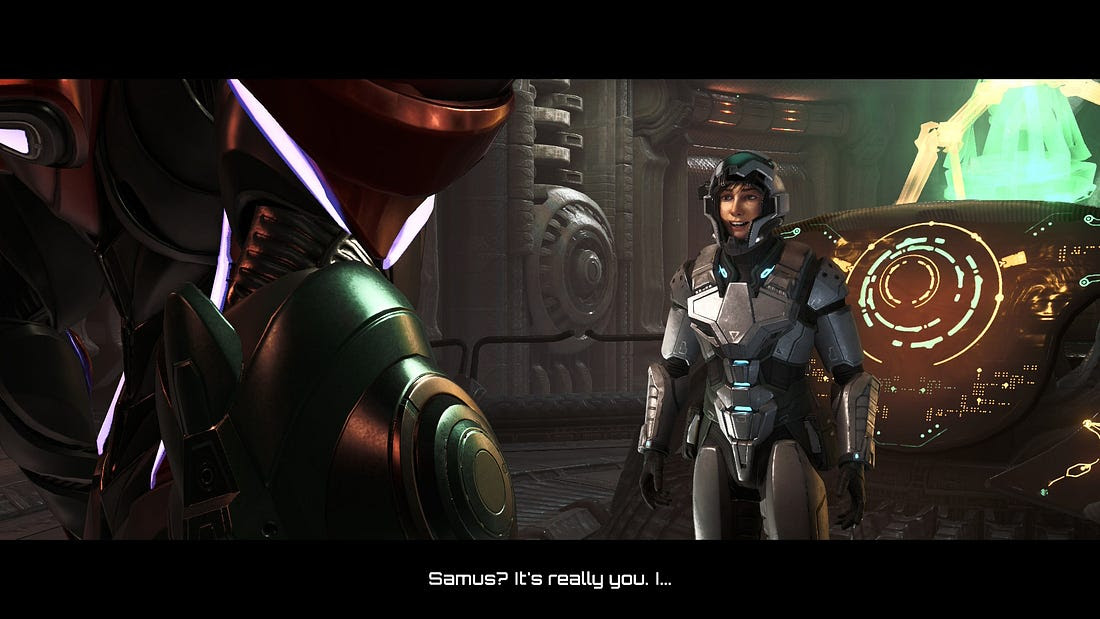
Does a Metroid game really need comic relief? Or Marvel-style quips?
See, Samus isn’t the only one to be warped to this new planet. Four other soldiers – and one combat robot – also survived the ordeal and are lost in various areas of the planet. You encounter your first one, Engineer Mackenzie, very early on, setting the tone for the rest of the game.
Beyond may forever be remembered for this one very early, very awkward line of dialogue from him: “You may want to scout ahead, it’s about to get very nerdy in here.”
It’s not just contained to one character either. Hours later, you’ll meet Armstrong, another trooper who basically fangirls Samus like she’s a pop star: “Wow… Samus, it’s really you. I… don’t know what to say… Is this a new suit?”
Collectively, they are Chekhov’s spaceship troopers, written into a plot that could function perfectly fine without them. Fully voice-acted, these figures are caricatures at best, and an annoyance at worst. They don’t get enough airtime or depth to add anything meaningful to the story. In fact, Samus spends part of her adventure babysitting them.
What’s worse: Samus is entirely mute in this game. I think that is the correct decision here, as Samus talking breaks her character, as we saw with another earlier Metroid game, Metroid: Other M. But her silence on occasion comes off less stoic than you would hope, and more like she’s incapable of replying.
While a lot of the Metroid Prime games have been fairly solitary, prior Metroid titles have had the bounty hunter joined by unlikely allies. But they’ve very much taken a backseat. Others have died moments from being introduced.
As such, I kept playing Beyond assuming there would be some kind of narrative payoff for their inclusion. Are they a psychic illusion, created by the Lamorn to push Samus towards their goal? Will they turn on you? Much like your fellow bounty hunters did in the third game, Corruption. While I played, I kept dreaming of ways in which these characters could add value to this plot.
I pined for a twist that just never came.
Indeed, the biggest surprise left hook this game delivered wasn’t a plot twist, but an end-game collect-a-thon that gated the final boss behind at least an hour of grindy Vi-O-La gameplay in the central desert area. For those playing: Do not ignore the green crystals mini-quest. You have been warned.
Almost 20 years, and still a bit undercooked?
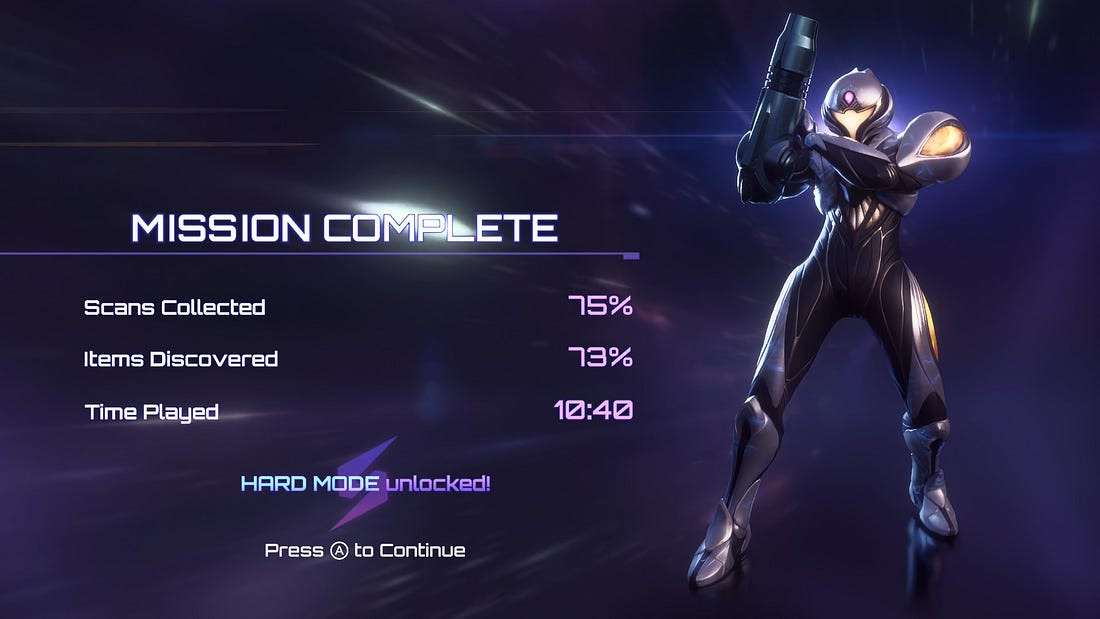
I just didn’t think it was worth going back for that extra 30%… many of the remaining items were buried down one-way paths
We’re left with a game that despite teasing of its release for over a decade still feels undercooked. Not fully realised. And ultimately, crushing as a result.
The game comes in at around 10 hours, making Samus’ latest romp both shorter than the past three games. There’s less content here than in Metroid Prime, the original, which takes on average around 15 to 20 hours for an initial unguided playthrough.
At $110 AUD for the Switch 2 edition, it’s a game that sadly I’d only recommend to Metroid fans or those craving a shooter game on the device.
In all honesty, if you are after the true Metroid Prime experience, play the reboot of the original. I’ve replayed it on the Switch, and it’s still fantastic. While there are some elements in Beyond that surpass the original, such as gunplay and graphical fidelity, it’s a truer representation of this genre of game. And arguably, a better game to boot.
More broadly, this release is a bit troubling for Nintendo.
Its games have typically been insulated from the turmoil facing the gaming industry. A safe bet, a haven for gamers as the industry sorts out its commercial realities. This Metroid game absolutely chips away at this notion.
We should have seen it coming. No game has seen such an extended development period and come out better for it. I can’t help but feel like this title will set up a revival of the series; it’s such an interesting and gritty universe with so much potential.
But given how long the last game took, I hope we’re all alive to see it.
Reviewed on: Nintendo Switch 2
Worth playing if you like: Doom: The Dark Ages, Metroid Prime 3: Corruption. Or, you can’t get enough of the Metroid universe.
Available on: Nintendo Switch, Nintendo Switch 2
- Harrison Polites writes the Infinite Lives newsletter. Follow him here.
Sign up for his newsletter below:
- Infinite Lives is a reader-supported publication. It’s free to sign up and read the latest piece, but as of July a subscription will be required to read Harrison’s backlog of over 100 unique articles. Each subscription goes towards improving his Substack, supporting the broader Substack gaming community and funding more independent games journalism in Australia.








Daily startup news and insights, delivered to your inbox.