

















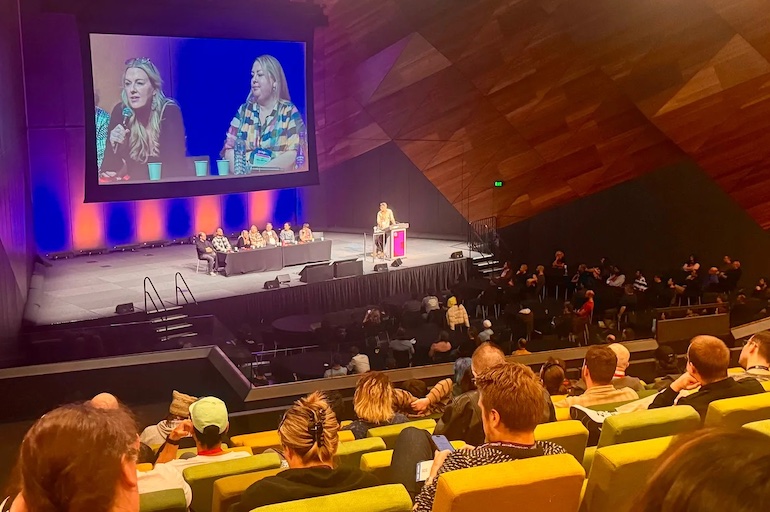
It wasn’t until late on a Wednesday afternoon, three days into the Game Connect Asia Pacific (GCAP) conference that the penny finally dropped.
Sitting in on an industry veteran discussion – or as they put it, “survivor’s panel” – I got an inkling as to why there was such a sense of business-as-usual for the local games industry this year. Something that’s very rarely the case.
As gaming industry author and QUT Associate Professor Brendan Keogh eloquently put it, the industry and its major stakeholders are now at peace with the idea that striking success with a game is the equivalent of “buying a lottery ticket”.
Building on this point, Trent Kusters, of League of Geeks’ fame, added that the industry is getting used to the idea of building on shifting sands; its new norm is that there is no norm. He encouraged the room to build into this, programming in both resilience and flexibility into the business design of new gaming studios, something that he believes isn’t discussed enough within the sector.
Speaking of hushed topics, while the looming impact of AI use in gaming was on the lips of many attendees, it wasn’t a focus of its many talks and panels. It scored just one closed-door discussion and a mention on this panel. Gizelle Rosman from Keywords Studios summed up sentiment nicely: “I hope the AI bubble bursts”.
In a gaming context, this makes sense. It’s still a raw topic. Uttering the letters “GPT” in GCAP’s halls would likely summon a pile-on of angry devs. Many are still reconciling whether it’s a challenge to their jobs, the art and ethics of game design, or both. The panel treaded lightly in addressing it. Antony Reed from Epic Games cautiously argued that the AI genie is out of the bottle, and that the industry need to define its use. It’s hard to say whether the start of that path emerged out of this event.
And while AI may be copping the heat right now, the real elephant in the room is Roblox. As Kusters put it: “The Roblox kids have escaped the pen.”
It’s one of the largest gaming platforms on the planet, at the height of its popularity among younger players. Not only is it inspiring the next generation of game developers, but it’s also morphing expectations of games for future players. Just like how watershed Nintendo 64 titles such as Super Mario 64 and Legend of Zelda: Ocarina of Time did for my generation.
Due to Roblox’s rudimentary graphics and simple mechanics, it’s dragging down a player’s expectations on photorealism or complexity in games. This, in turn, may open a door for local indies.
The panel’s youngest participant, Gravity Well’s Joshua Caratelli chimed in here. He said the Roblox generation will soon enter the industry, and they will be pre-armed with a myriad of game design skills, and expertise with various coding languages from the build-your-own-game nature of that platform. Though he added, despite these remarkable skills they are broadly still anxious about being able to find a job in the games industry.
Building on Kusters earlier point about topics the industry itself are not talking about, in my three days at GCAP I couldn’t find a session or mention on price increases across gaming, despite the focus its getting just about everywhere else.
This is interesting for our local sector, as rising prices across the world’s premium gaming products may actually drive more all players towards more affordable indie Australian games. Especially, given, as panel host Morgan Jaffit put it, the “COVID funny money”, largely deployed in larger markets abroad and fuelling massive AAA titles is starting to dry up, as reflected by large layoffs and massive game cancellations abroad.
For consumers, the contrast is stark. Purchasing two indie Game of the Year contenders last month, Hollow Knight: Silksong and Hades 2 combined ($74.50 AUD), costs players just over half the price of entry for Sucker Punch’s big new Playstation exclusive Ghost of Yotei ($124.95 AUD). That’s not to mention device price rises, and Xbox’s 50% Game Pass price hike just last week. This may have factored into discussions held by Sony and Microsoft at the event about their respective game distribution ecosystems, but much like the AI discussion, those too were off limits to the media.
There’s plenty of both opportunity and challenge for the sector in the years ahead. And from what snippets I gathered talking to attendees over the three days, Australia’s gaming sector is actually well placed to handle them. Despite the constant headwinds, that feeling of stability actually makes sense.
It would just be nice to write that with some form of certainty. I can’t help but feel many of the most meaningful discussions at this event weren’t on the mainstage and were carried out in rooms away from the prying eyes of media. But much like our game devs with their “lottery tickets”, I guess I’m feeling lucky.
A happy ending for CONSCRIPT
 |
Changing gears now to some smaller news that came out of the event. Over a year after its release, solo developer and Australian Game Developer Award winner Jordan Mochi provided the conference with an update on the sales of CONSCRIPT.
While it’s been a slow burn, the game has amassed a level of success, with Mochi saying that it sold 80,000 digital copies. The average Steam game sells around 32,000 units.
It’s a satisfying end for Mochi’s story, and sales may continue as his game is ported into more bundles and deals. In an interview with Infinite Lives last year, Mochi lamented the lack of conversion of his 165,000 wishlist.
“Perhaps the only box I didn’t tick is luck,” he said at the time, adding that he was in discussions with his publisher Team17 on how to translate more of his wishlist into sales. While he may not have hit the jackpot, he’s still a winner.
Don’t worry, your Neopet from 20 years ago isn’t dead. It’s just starving.
 |
For the second year in a row, Neopets CEO Dominic Law presented at GCAP on the progress of revival monster-oriented flash game from the 90s.
Asked why he repeated his chat, Law mentioned that Australia is one of the NeoPets top five markets, and game developers are among its most prolific players. To this point: The company is giving another talk this weekend at PAX Australia, and currently has an exhibit open at ACMI Game Worlds as part of Melbourne International Games Week.
For context: Neopets was revived by Law, a former player of the game, two years ago, after he convinced his former employer NetDragon to give him a shot at resurrecting the neglected intellectual property. NetDragon acquired Neopets parent company, Jumpstart, in 2017.
So far, its working. The NeoPets online game is currently at around 400,000 monthly active users — up from 150,000 in 2023 — with the aim of turning more if its 150 million registered users into return players.
As for the strategy going forward, Neopets aims to partner with Australian brands for activations using their monsters and mascots. Mass marketing has been ruled off the cards for now, but it will also soon launch a campaign encouraging players to rediscover their pet from their childhood. “Neopets never die,” Law said. “They starve, but they are still alive.”
Can’t remember your login? Or was it made with an awkward email address from your teens that you are too embarrassed to resurface? No worries. Neopets is also implementing a system where low-value accounts will require simplified credentials to both track down and reset the account.
Melbourne’s The Drifter cleans up the Australian Game Developer Awards
 |
And finally, the dark, story-based point-and-click adventure game The Drifter has scored the top gong at the Australian game industry’s night of nights.
Developed by Melbourne-based studio Powerhoof, the game pushes new ground for a genre made popular by other games such as Monkey Island and Disco Elysium. The full list of winners and links to their games are below.
- Game of the year: The Drifter by Powerhoof
- Excellence in art: The Drifter by Powerhoof
- Excellence in gameplay: Mars First Logistics by Shape Shop
- Excellence in narrative: The Drifter by Powerhoof
- Excellence in sound design: The Drifter by Powerhoof
- Excellence in music: Tempopo by Witch Beam
- Excellence in accessibility: Tempopo by Witch Beam
- Excellence in mobile: Feed the Deep by Luke Muscat
- Excellence in Extended Reality: Shattered by PlaySide Studios and Meta
- Excellence in Impact: Copycat by Spoonful of Wonder
- Excellence in Debut: PROXIMATE by Cain Maddox
- Excellence in ongoing: RISK: Global Domination by SMG Studio
- The Rising Star: Aiden Gyory, Catalyst Games
- The Adam Lancman: Antony Reed, Epic Games
- Studio of the Year:Massive Monster, maker of Cult of The Lamb
- Harrison Polites writes the Infinite Lives newsletter. Follow him here.
Sign up for his newsletter below:
- Infinite Lives is a reader-supported publication. It’s free to sign up and read the latest piece, but as of July a subscription will be required to read Harrison’s backlog of over 70 unique articles. Each subscription goes towards improving his Substack, supporting the broader Substack gaming community and funding more independent games journalism in Australia.



Daily startup news and insights, delivered to your inbox.