
















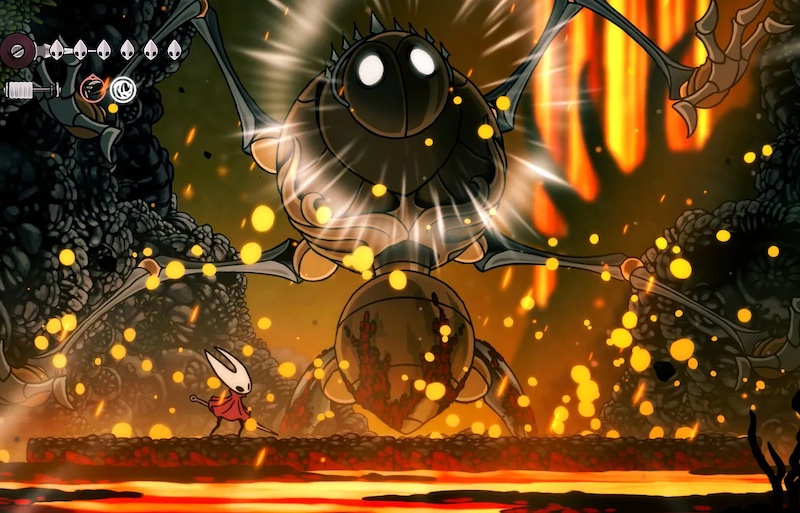
It took almost eight years for the downloadable content turned into a fully-fledged title to go from idea to release.
A determined fandom and a vacuum of information created its own brand of gaming community conspiracy theories around the title. With less than a few breadcrumbs of information, the game remarkably sustained a full near-decade of interest, perhaps unlike anything before it.
So when news came out of a launch date, the internet, of course, exploded.
The Adelaide-made title stole the show at this year’s global Gamescom event. As sourced by Footprints.gg and reported by the GameDiscoverCo newsletter, it generated over 1,000 press mentions globally, pipping other major long-running, well-marketed franchises such as Metal Gear Solid, Silent Hill and Resident Evil.
Meanwhile, other indie developers have reportedly moved the release dates of their games to accommodate it, much like what we’ve seen with the launch of Grand Theft Auto 6.
That’s not all. In an interview with Bloomberg’s Jason Schreier near the time of the game’s release date reveal—the only one to date—Team Cherry developers Ari Gibson and William Pellen revealed that the first game had sold around 15 million units, possibly making it one of the best-selling indie titles of all time.
This all adds to the mounting evidence that Hollow Knight is quietly a major cultural export for Australia, biting at the heels of cartoon series Bluey and film Crocodile Dundee.
The former is valued at around $US2 billion, and the latter turned a gross figure of $US328 million at the global box office. Back-of-the-envelope maths put Hollow Knight at hundreds of millions in gross revenue, not quite hitting the highs of our greatest cultural exports, but still, undeniably a massive success.
What’s baffling, however, is that major media attention here in Australia couldn’t be more subdued.
As of Wednesday night AEST (3 September), Silksong or the original Hollow Knight has barely registered a recent mention among Australia’s major publications or media networks. There are no billboards or fanfare here.
While that isn’t too surprising given the decline of gaming journalism in Australia, this is a bigger story that should fit outside of the beat. It all begs a broader question: why isn’t this game being championed as an Australian success story?
Measuring success
Part of the answer may lie in just how hard it is to empirically measure the success of a game—to a level that is reasonable for broader purposes outside of the industry.
Gaming sales figures aren’t always openly disclosed. While larger global developers may provide them as part of their annual results, indie studios aren’t under any obligation to reveal them. Simon Carless, analyst and author of the GameDiscoverCo Newsletter, explains the challenge. As he told Infinite Lives, educated estimates end up filling the void.
“We’re looking at various public—and sometimes private—data points, including reviews, concurrent users, public profile players, followers, and so on,” he said.
“Some companies get data directly from companies and make it available only to other companies that sign up, but that’s generally an older model that was most suited to the physical game sales world.”
He adds that there’s plenty of other mediums where their success is summarised in estimations, including books, music and TV shows.
“People want data,” he says. “Really, it’s market intelligence as a whole, not just sales numbers, because they want to understand what’s actually popular, the overlap of players, how long they play games for.”
The data is mainly used to help other developers understand the market ahead of launching their own title, and as such tends to stay in those circles.
“You can’t plan to make successful games unless you understand what is currently successful.”
Is ‘self-promotion’ a dirty word in Australia’s game dev scene?
The other part of the equation is self-promotion. Without clear indicators of success to propel local media into action, it falls to Team Cherry to promote their acclaim. But here’s the thing: they’re not.
Culturally, Australia is a bit unique in that we, as a country, tend to err towards quiet achievement over broader appeal or recognition.
Alex Venville, Australian solo game developer and game trailer creator, agrees. “It’s possibly true because I guess a large percentage of videogame developers in Australia are introverts?” he suggests. “They would rather let the results speak for themselves.”
Venville, who used to work at EA’s specialist mobile gaming division Firemonkeys, also argues that because Hollow Knight isn’t innately a portrayal of Australian culture, it’s easier to ignore.
“I think it’s much easier for a major news organisation to publish something about a cartoon blue heeler dog, or a cheeky goose—regardless if it’s a videogame or not—because as people, we all like to feel validated by reading about the success of our own culture.”
He hints here at the stark contrast between Hollow Knight and another Australian title, Untitled Goose Game. It’s a success in its own right, last reported in 2020 to have sold 1 million units. But it’s generated a swath of headlines both locally and globally, linked with its Australian heritage, and has seemingly courted the publicity too.
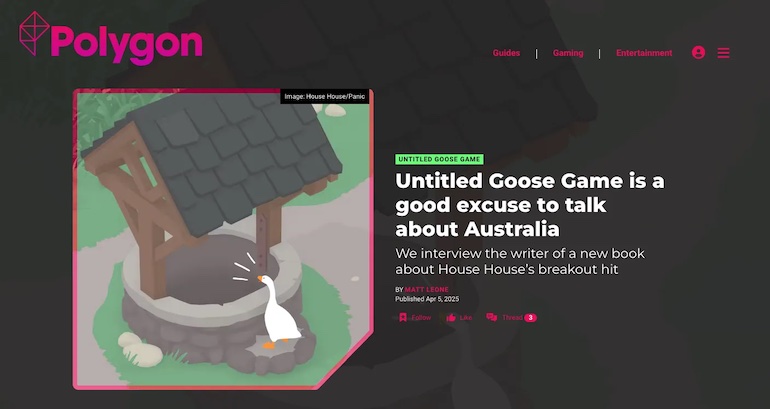
You can take the Goose out of Australia… but Australia is well and truly connected to the Goose.
Zooming out from Hollow Knight, there’s a broader point here around a greater good of clear and candid disclosure of success within the Australian games industry.
The sector is primarily supported through grants and government assistance from both state and federal bodies, which are highly susceptible to fluctuating budgets and shifting government agendas.
These stories, told locally and in publications that policymakers read, help insulate and possibly grow their reach. But we can’t ignore the trade-off: privacy. This shouldn’t be underestimated in light of just how much obsession, attention and fandom games can receive.
Perhaps there is a balance that can be struck.
Aside from hunting down news pieces, I have one other barometer on this issue, though it’s far less empirical.
When I wrote about the game last year, in anticipation of more Silksong news (that never materialised), later that week after it went live one of my friends remarked: “I genuinely never knew Hollow Knight was an Australian game.”
So. Will you be booting up Hollow Knight: Silksong today? Are you only just learning from this column that it’s Australian-made? And are you surprised to hear about the lack of attention this game is getting here? Let me know.
- Harrison Polites writes the Infinite Lives newsletter. Follow him here.
Sign up for his newsletter below:
- Infinite Lives is a reader-supported publication. It’s free to sign up and read the latest piece, but as of July a subscription will be required to read Harrison’s backlog of over 70 unique articles. Each subscription goes towards improving his Substack, supporting the broader Substack gaming community and funding more independent games journalism in Australia.




Daily startup news and insights, delivered to your inbox.