
















What is bravery? Are there different types of courage?
And how does your age, gender, race, and leadership style impact your bravery score?
I first met Crista Samaras on a summery NY afternoon, in The Post clubhouse – a community for athletes in business. I’d spent the afternoon with Christian, the founder. She’d spent it running workshops for elite athletes. We were both on our way out.
Crista is athletic (former lacrosse athlete) and bounced with energy even after spending hours running workshops. So I said hi.
And when she told me her specialty was bravery, I waylaid her. She taught me more in a single conversation than entire books on the topic.
That was two years ago. Today her decades of research and insights through her company Brave Enterprises are the inspiration for this five-part series of blogs:
- World-first research on bravery. 7 findings that will overturn your beliefs (this blog)
- Bravery > confidence: Don’t fear less, brave more.
- Bravery is not a feeling, it’s a skill. 5 techniques to master it.
- The only 3 questions you need to make brave choices
- Why I refuse to talk about impostor syndrome (and you should too)
We’re going to start with Crista’s data.
What is bravery?
Ask people what comes to mind when you say ‘bravery’ and they’ll tell you: ‘hero’, ‘firefighter’, ‘soldier’, ‘war’, ‘skydiving’.
Outside of physical bravery, it’s a word that’s fallen out of fashion. Rarely do we say ‘I wish I was braver’ or ‘I want more courage’. Instead we all ask for more confidence (more on this in part 2). Perhaps because to be brave, you have to admit to fear. And admitting you have fear is almost shameful.
“I learned that courage was not the absence of fear, but the triumph over it. The brave man is not he who does not feel afraid, but he who conquers that fear.” ~ Nelson Mandela
Defining bravery is the first challenge. Crista’s team reviewed the literature and found:
Scholars, thinkers and civilisations have been arguing over what constitutes bravery for as long as the written word has existed. Just one summary list from Rate et al. (2007), for instance, captures 29 definitions pulling from literary, philosophical and psychological history. Aquinas, JFK, Hemingway – men through the ages (and those documented are of course male) all had something to say about courage.
But those 29 definitions, for the most part, share four common elements. Bravery requires:
- A goal or purpose worth striving for (without this it’s mostly thrill-seeking or recklessness)
- Personal risk
- Feeling fear
- The choice to act
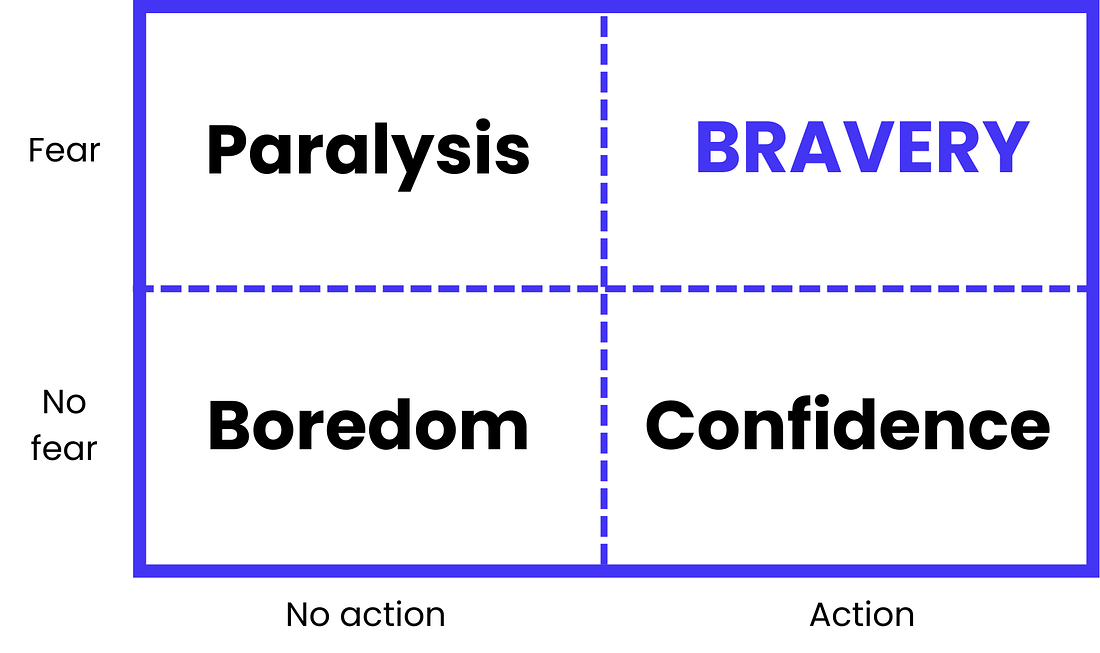
Ultimately, I think of bravery as: ‘Action in the face of fear’.
“The opposite of courage is not, as some argue, being afraid. It’s apathy. It’s disenchantment. It’s despair.” ~ Ryan Holiday
3 types of bravery
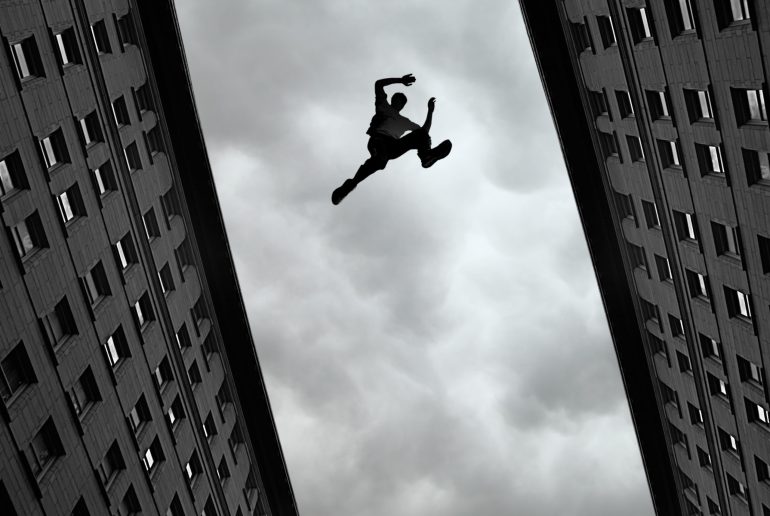
- One: Imagine standing on the edge of the cliff, looking down. Waaaaaay down.
“Ready to jump?” asks your paragliding instructor
“Umm, you’re sure it’s safe, right?”
You glance down one more time … gulp.
“Of course. We’re just going to run right over the edge together. On the count of three …”
This is physical bravery. And the one we are most comfortable admitting to. The risk is death or injury.
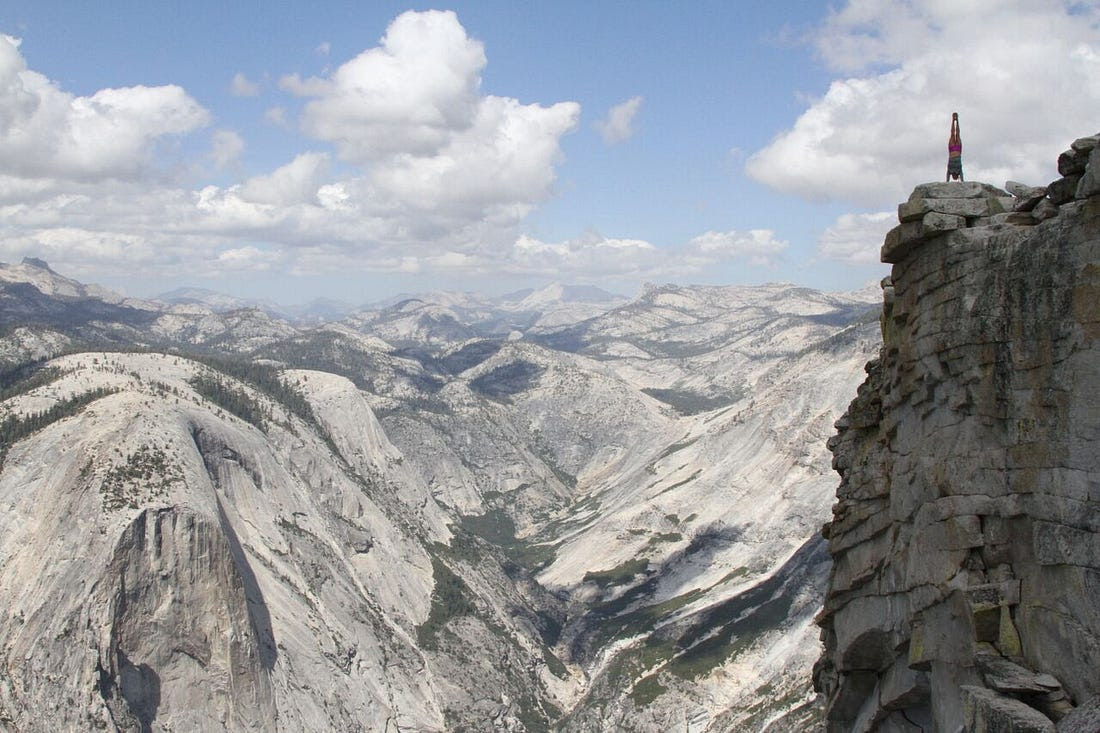
Doing handstands at 2694m on the top of Half Dome, Yosemite.
- Two: “I was wrong,” a hush falls over the auditorium.
Imagine standing on stage, with your research behind you, and admitting this? Your career at stake.
“I found a flaw in my methodology. The papers I published … they aren’t right. I want to help correct them.”
This is psychological bravery. We are facing a painful aspect of ourselves. The risk is that we are seen, and judged, differently.
- Three: “Mei is pretty good at her job … for a diversity hire,” John casually says at lunch with your team.
Your colleagues laugh, a little awkwardly. Then silence descends on the table.
“The other day I even saw Mei…” John starts up again.
“Stop,” you say. “None of that is true, and it’s hurtful.”
“I’m just joking,” he mutters.
“It’s not a joke, we need to do better,” you say.
This is moral bravery. It’s speaking up for what is right and ethical. The risk is to your reputation and social standing (and often it’s a risk to the victim’s reputation too).
7 research findings that will change how you think about bravery forever
All of the below research is a credit to Brave Enterprises. Over the past decade, they’ve run over 500 bravery training sessions, for 20k people, ranging from teens to adults. Most importantly, they collected data.
That data has been independently analysed by Motivate Labs. It’s unpublished, so this is your first look.
One important thing to note:
Although bravery and confidence are not the same (more on this in blog two), they are correlated to a statistically significant level. As bravery increases so does confidence. People can struggle with rating their bravery, so the Brave Enterprise team also asks questions about confidence.
Now to the findings:
1. Males rate their own bravery higher than females do
When asked to self-rate their bravery on a scale of 1-10, males come in a lot higher than females.
- 8.1 = average bravery score for males
- 6.7 = average bravery score for females
This doesn’t mean males are braver, simply that they believe they are. But belief is often the first requirement for doing brave things.
2. Relative to peers, males think they are braver, too
“Do you think you are more confident, as confident, or less confident than your peers?”
How would you answer?
It turns out that only 12 per cent of males rate themselves as less confident than their peers. For females? It doubles to 24 per cent.
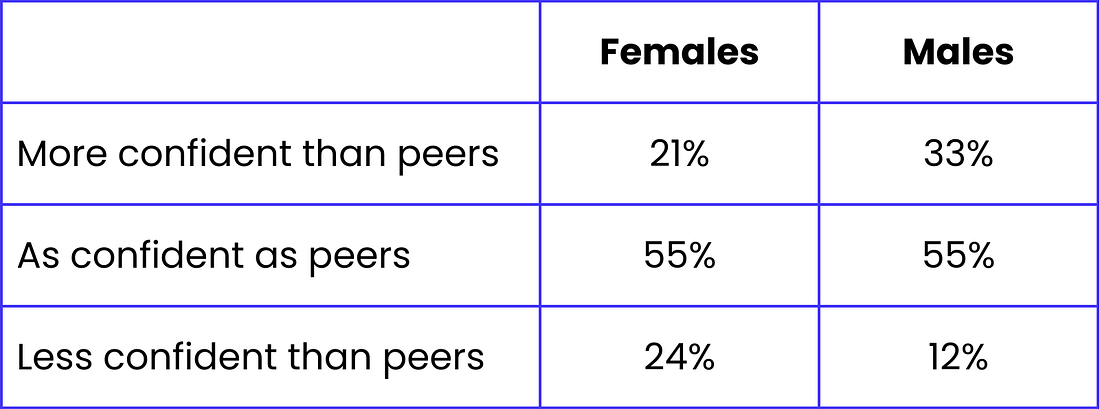
The above figures also go in opposing directions with age.
For females, the proportion who feel less confident than their peers peaks in high school and college at around 25 per cent, and improves to 19 per cent in adulthood
For males, the proportion who feel less confident than their peers is in the 9-11 per cent range during high school and college, but rises to 15 per cent in adulthood
Relative to peers, females feel more confident as they age. Males feel less so.
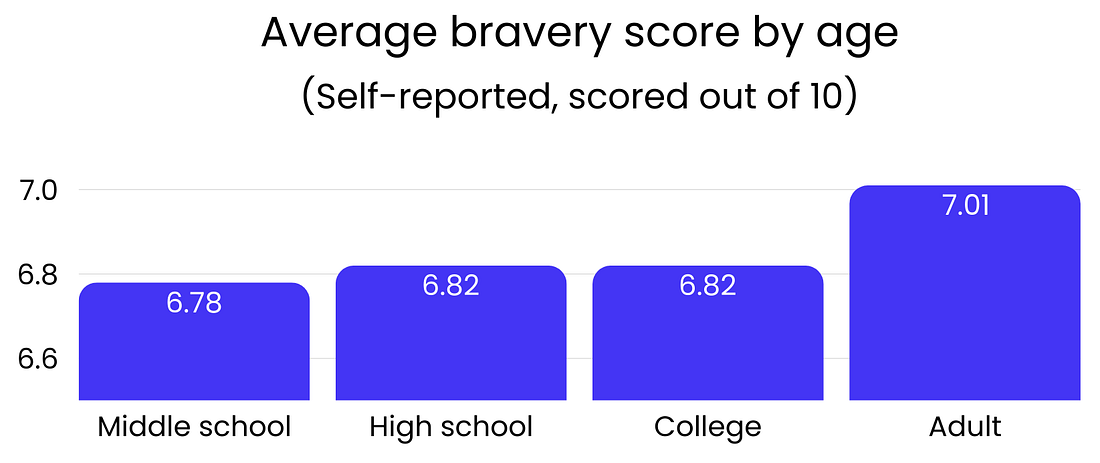
3. Bravery increases with age
Bravery is lowest between ages 9-22, and then very slowly increases each year up to age 55.
We also know that the inflection point for fear is roughly age 12. That’s when mostly physical childhood fears fade, and we start to understand that psychological and moral fears are far scarier.
4. White people are not the bravest
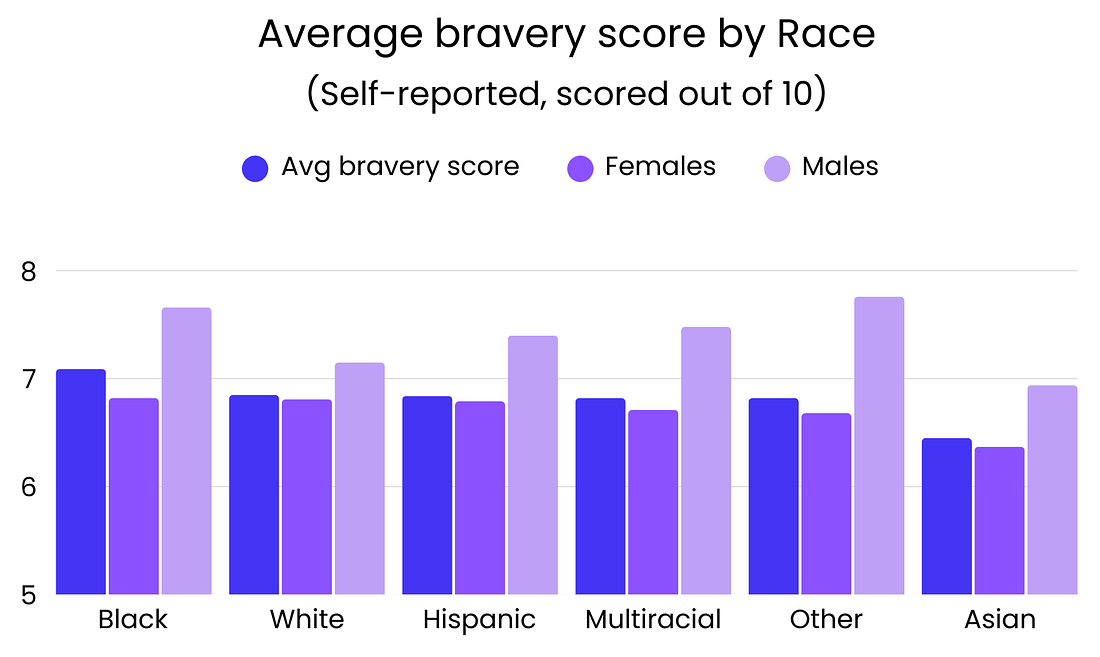
For all of the things that white people consistently rank higher on – employment rates, income, wealth, health care access, criminal justice outcomes etc – bravery is not one of them.
Black individuals are, on average, the bravest cohort. Asian individuals tend to feel the least brave.
Keep in mind this is US data.
5. The biggest fear is failure
Contrary to the popular myth, for the majority of people their biggest fear is not public speaking.
For 74 per cent of people, their number one fear is failure, or things related to failure like not living up to expectations (self or other) or disappointing someone (self or other).
The number two fear is loss. This figure climbed significantly during and after the COVID-19 pandemic.
Our fears are universal. You’re not alone.
“According to most studies, people’s number one fear is public speaking. Number two is death. Death is number two. Does that sound right? This means to the average person, if you go to a funeral, you’re better off in the casket than doing the eulogy.” ~ Jerry Seinfeld
6. Our bravery role models are becoming more varied
One of main strategies to increase your bravery is to witness someone else taking brave action. (We’ll get into all of these strategies in blog three in this series). TLDR, role models matter.
In the past, when asked who their role models are:
- Boys looked to external heroes – firefighters, athletes, Marines, YouTube influencers
- Girls looked to community heroes – parents, teachers, coaches, people they know
The hypothesis is that young women didn’t have aspirational heroes to look up to in the media, and so they had to look locally.
That’s changing – for both groups – in two ways.
- Girls are looking up and out to heroes like Simone Biles, Taylor Swift, Michelle Obama. And boys are looking inwards to their communities for local brave heroes.
- Girls and boys are identifying a lot more with heroes of both genders, not just their own gender.
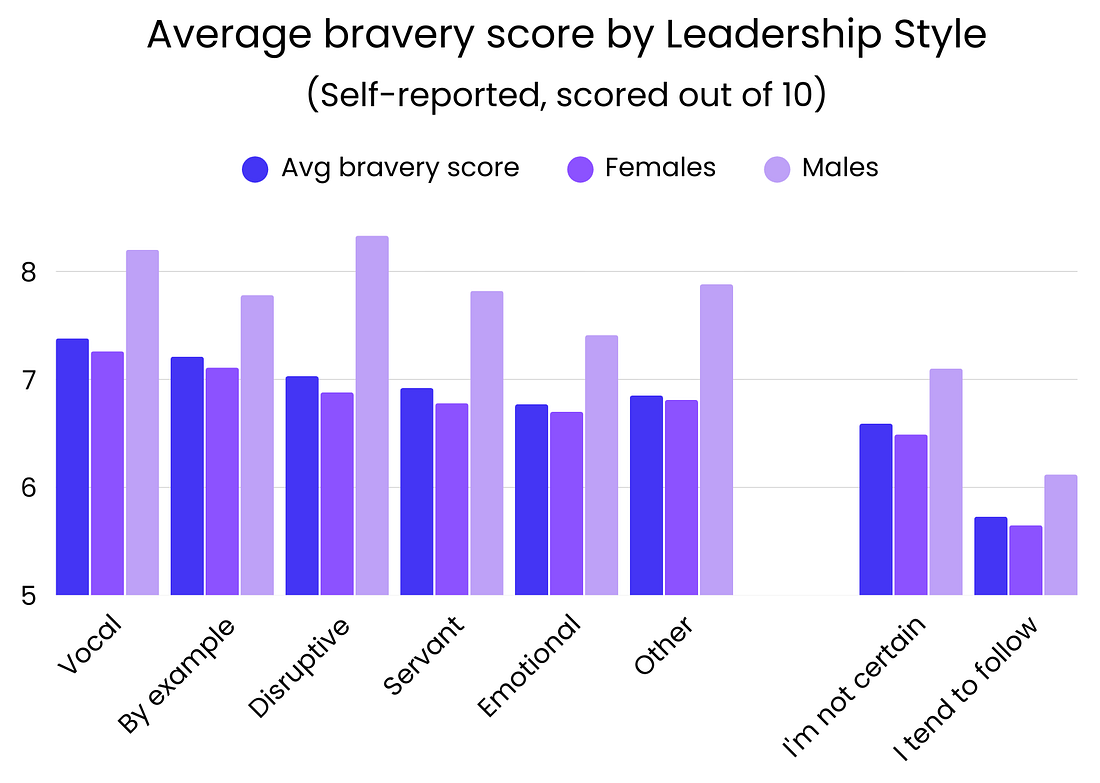
7. Leadership styles impact bravery
What kind of leader do you think you are? Do you lead vocally, by example, with a servant style? Or are you more of a follower?
The answer impacts bravery scores.
Interestingly, 22 per cent of people aren’t certain what kind of leader they are yet. In helping them discover that, there is an opportunity to build more bravery.
Summary
Two reminders to conclude:
First, bravery requires that you feel fear AND take action.
Think of the last time you were brave. I doubt you were running into a burning building. You may have admitted you were wrong. Tried something new. Shared a vulnerability. Stood up for someone who was mistreated.
“Courage is resistance to fear, mastery of fear, not absence of fear.” ~ Mark Twain
Second, data always consists of averages. If you are young, or Asian, or prefer to follow rather than lead it does not mean you are not brave. You are an individual, you are not a statistic.
“It takes courage to look at the averages and say ‘I am not average’. To say ‘Somebody will be the exception and it may as well be me.’ That’s what courage is.” ~ Ryan Holiday
A huge thank you to Crista and her team at Brave Enterprises for sharing this data.
- Christie Jenkins is the managing director of Techstars Sydney. This is the first in a series of 5 essays on bravery. You can read more at christiejenkins.com.au



Daily startup news and insights, delivered to your inbox.