











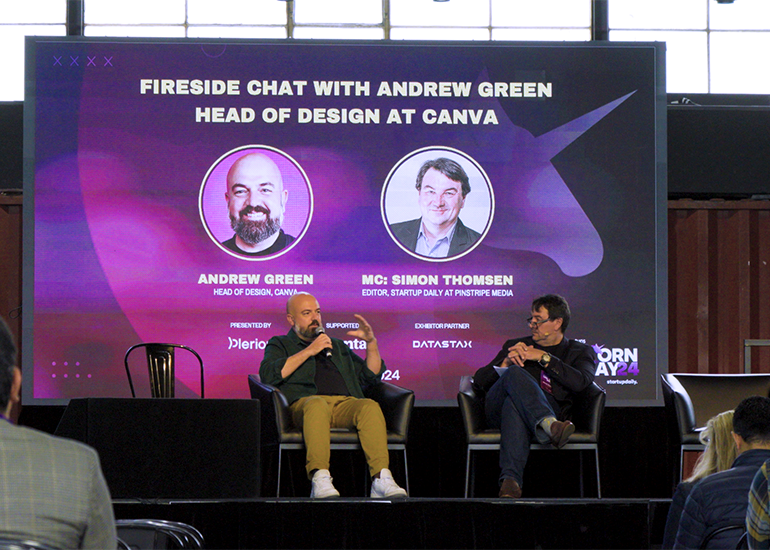
Innovation means different things to different people, but the most important thing when it comes to product development is to have a clear vision, according to Canva’s Head of Design, Andrew Green.
“‘We think pretty deeply about our roadmap, and for all the founders out there, I think that one interesting aspect of [Canva cofounder and CEO] Mel’s vision is that she had a lot of it really well-thought out very, very early and was very committed to it. So we had a really strong roadmap,” Green said at Startup Daily and AWS Startups’ first-ever Unicorn Day in Melbourne, sharing his insights into creating products the world loves.
Canva is now one of Australia’s most successful tech companies, worth $49 billion from delivering on its mission of “empowering the world to design”.
The 40-minute deep dive into how Canva builds products used by more than 220 million people in 120 countries globally was one of the highlights of Unicorn Day, where founders learned the secrets of building and scaling a billion-dollar business from industry heavyweights including Zeller CEO and cofounder Ben Pfisterer, Aconex cofounder Leigh Jasper and leading VC investors.
The event lineup featured guests from across the Victorian tech scene, the AWS Startups ecosystem and Australia’s elite group of unicorns, including Canva.
A roadmap for founders
Green provided his own roadmap for startup founders when it comes to developing successful products and how to approach the challenge.
His key lessons included:
- Investing in the performance and functionality of core products early on, even if it involves rebuilding existing features, is essential for scaling and sustaining growth.
- While customer feedback is crucial, innovative products often require intuition and risk-taking. Even products that don’t succeed immediately but can thrive with iteration and perseverance.
- Shipping imperfect products early can validate ideas and build momentum. Iteration and user feedback over time refine and enhance the product.
- Long-term investment in artificial intelligence will be central to Canva’s ambitions when it comes to enhancing workflows and boosting creativity.
“When I first came into Canva, we were actually just rebuilding things that already existed,” Green recalls.
“Because we really knew that we needed to invest at that point. So at that point, you just know you need to build those really solid foundations. I think for any founders out there, that’s so important that you’ve got that built.”
“Not everyone was going to love it, and that was okay”
For Green and his team, that work was all about fulfilling Canva’s mission of empowering the world to design, on any device.
“We had this concept that we wanted to make people that are creative more productive or more productive people creative, which sounds very philosophical,” he said.
“I think that’s a thing that we also do with product thinking: Canva is very philosophical, but then we want to jump straight into shipping something.”
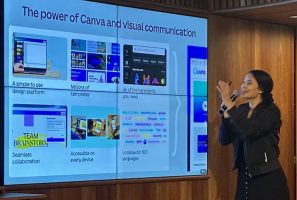
Canva cofounder Melanie Perkins introduces the new features in the company’s worksuite product in 2022.
The rubber hit that philosophical road two years ago when Canva launched its online graphic design tool Visual Suite. It was an ambitious AI-powered project spanning docs, websites, videos, whiteboards and more.
Green confessed that “we knew that not everyone was going to love it, and that was okay”.
But the lesson is to launch, then listen Canva talks to its customers a lot, collecting 4 million data points in the last year from their feedback.
“It’s really important to have a moment in time where you get something shipped and you get it out there. Yep, people might not love it, but if you have a strong belief that people will love it, if you keep trying and keep iterating on it, then it’s always been worth it,” he said.
“I think that just comes from some intangible beliefs that you must have in product development around things like: I might not have all the data.
“When we launched Presentations… we just had a belief that there was a better way. And, at first, it wasn’t a successful product, but we knew that if we kept honing and honing and really looking at features that we know people depended on, and then features that we knew would really wow people… to get this really winning combo.
“Obviously science is a big part of it – looking at data – but I also really believe in just having that kind of vision that you want to stick to underpinned by a big mission – power the world to design – and underneath that, there are all of these things that we know we need to do to get there.”
The power of “informed simplicity”
Part of that thinking is what Andrew Green calls “informed simplicity” – balancing user feedback with product functionality to ensure tools are both powerful and accessible.
“Informed simplicity is a world where you’ve converged a lot of things. You’ve thought really deeply about how to bring buttons together, how to bring flows together, how to merge dropdowns, and how to actually think about even if a line is doing its work on a piece of UI (user interface) – and if it’s not, then let’s get rid of it,” he said.
“Those kinds of calls are often the hardest ones to make, and that’s where we spend a lot of time in our internal reviews. We do a lot of reviews internally around informed simplicity: how we got there, could we do another? Could we push it a little bit more to be as simple as it can be? And that’s actually a big ethos in the product design team.”
But there are limits for Canva’s design boss, especially when it comes to the design thinking movement – and it’s a lack of ownership from designers who build things from user feedback only.
“They think ‘I’m just gonna build something that I’ve been told to build, hey, I’m just putting it out there into the world’. And what happens then often is that it goes out in the world and then that design will go: ‘Oh, it didn’t work or it was often it’s just mediocre, like it wasn’t really as good as it could be. It’s not my fault, we talked to the customers, they didn’t want they said that they wanted this thing, we built it’,” he said.
“Whereas someone that owns something, if they launch it and it’s not great, they’ll just be so stubborn and hustle so hard to make it great, then that’s like that last bit that you really need, I think, in a product company.”
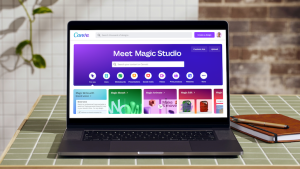
Canva’s AI tool Magic Studio
Green confesses it “sometimes scares me” how many engineers are involved in thinking about “how much code they’re writing and deploying into the product”. So making sure everyone’s aligned with what everyone else is doing is vital.
“We have this internal thing called a jigsaw that all kind of fits together like a jigsaw in the end. And it’s really important to think like that,” he said.
“So you can create a simple product as a leader by making sure the teams are jigsawed together really nicely, and then the teams that are in there are thinking about their part being really informed and really simple.”
And that’s where cross-disciplinary collaboration becomes vital. Canva focuses on having small, diverse teams of designers from different disciplines, avoiding siloed roles to streamline the creative process.
Asked about culture, especially when you’re dealing with people with strong opinions, Canva’s Head of Design outlined several important ways they address the challenge.
“It’s really important to have opinionated designers in your design team. I cannot stress that enough,” he said.
“And often opinionated designers come from a place of having built up instinct about what will work and quickly being able to bring it to life, and they’re the people you want in your team. They’re able to just synthesise the data but then go: ‘this is what it means for the product’, and I also know that founders prefer to work with those types of folks because you can get moving really quickly and especially, you know, getting in line with the same philosophy.”
Staying small
Part of Green’s solution for tackling all those opinions and feedback is to maintain smaller teams.
“I find that that’s really important with design teams in particular, to have an absolute maximum of five designers on a team – usually less – all from different parts,” Green said.
“So get a motion designer to go work with a product designer, to go work with a brand designer – they’ll create something magic like most times.
“And that just comes about from giving them freedom, giving them a really clear problem to solve, rather than sort of overburdening people with a team that’s only owning little tiny slices of a process.
“That’s something I’ve seen happen with scaleups. They start to get that to happen in their product design process where they’ll get someone that just does this part of the process, like research, someone just does this part, like, maybe the wireframing and then the prototyping and then the visual design, the branding. It’s way better, I think, to get people that can really do their whole thing.
“That’s when you can take those risks of ‘let’s build something that no one’s ever seen before. Let’s really push it’.
“I think people that have that kind of skill set want to do big things. They want to create big things. They don’t just wanna do their part of the process and hand it on to the next person.”
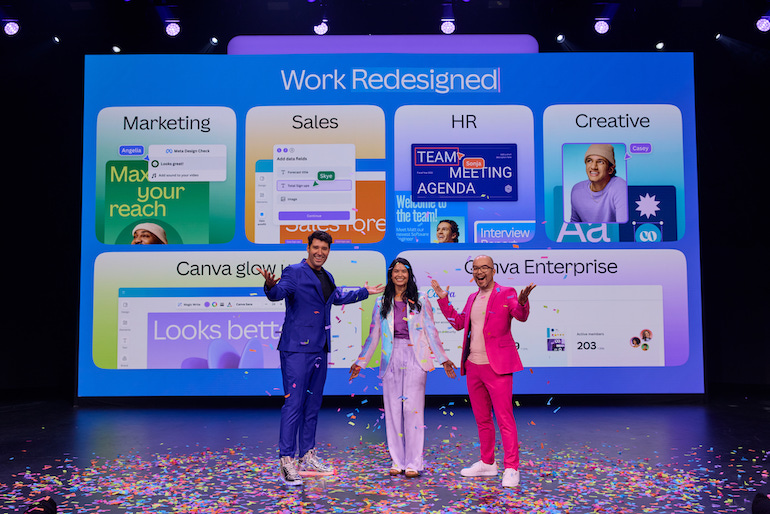
Canva cofounders Cliff Obrecht, Melanie Perkins and Cameron Adams. Photo: Supplied.
Spicy but safe debate
To address conflict in the decision process, Canva has a process they call spicy but safe, but again, Green argues that the secret is to keep things small.
“We want everything to feel spicy but safe, and I don’t think that happens in large groups of people. I made a big mistake of keeping our design team having one meeting until we were about 30 people.
“People stopped sharing openly in that size. I remember the moment we were like, ‘okay, we’re breaking every team down’. You can’t have critiques of any more than five people in a room. And that’s going to mean some people are gonna feel left out. That sucks.
“But I think for a trade-off of keeping a very opinionated culture that we value, it’s what we have to do. We want everything to feel small, and if it feels too big, you cancel the meeting, and you cancel the team weekly, whatever it is, and break it up into smaller pieces.
“That’s something that I think as a leader as well, you need to look for as you see teams growing… asking questions like, how is this team running? What’s the culture in it? And doing a bit of a dipstick test on that team and making sure that they’re actually aligning with the culture.
“So I think that’s a big part of it, making things feel small.”
Canva now has more than 5500 employees around the world, including design teams in 16 locations, thinking small in very big ways.
This article is brought to you by Startup Daily, supported by our Unicorn Day partner AWS Startups. AWS Startups provides free tools, resources, and content designed to simplify every step of the startup journey. Find out more here.




Daily startup news and insights, delivered to your inbox.