


















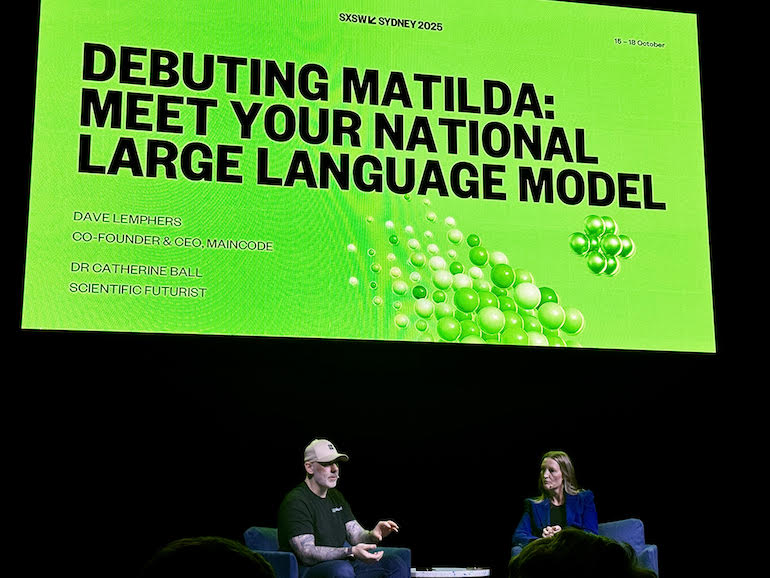
By the time I slipped into the packed SXSW Sydney expo theatre, the crowd was already deep in discussion.
On stage, Dave Lemphers, cofounder and CEO of Maincode, sat alongside Dr Catherine Ball, steering one of the most grounded, technical and groundbreaking conversations of the festival: the debut of Matilda, Australia’s national large language model.
For those unfamiliar, Maincode is the Australian AI company quietly building the country’s full-stack capability from data infrastructure and model training to application deployment.
Their ambition is simple but bold: to make Australia self-reliant in artificial intelligence by creating models built, trained and run entirely onshore. The company’s AI Factory concept where custom, domain-specific large language models are engineered from scratch positions it at the forefront of a new era of Australian-made AI.
This was my third SXSW Sydney and my first session to attend this year as an official judge of the 2050 Content Track.
I arrived just in time for the audience Q&A, which turned out to be the real highlight revealing not only the intelligence of Matilda’s design, but the values behind it.
On data, copyright, and paying creators
An audience member asked how Maincode planned to handle copyrighted material and whether creators would ever see royalties from their work being used to train AI.
Lemphers answered with precision. He described “traceable tokenisation” a system where every dataset could be mapped back to its source, allowing fair attribution and even payment.
“Big incumbents want you to think this is a technical problem,” he said. “It’s not. It’s a business decision. You can absolutely build this in from day one.”
It reframed one of AI’s biggest controversies not as a limitation of technology, but of good will.
On sovereign vs. “Australian-made” AI
Another question touched on national security and sovereignty: should every country build its own AI model?
Lemphers’ take was refreshingly pragmatic. “We’ve stepped away from ‘sovereign AI’ and toward ‘Australian-made AI’,” he said. “It’s not about isolation. It’s about innovation. We build it here, secure it here, and make it in a way that reflects how Australians do things, like we did with Wi-Fi.”
Maincode’s Model Factory approach, building end-to-end from infrastructure to training, lets organisations run models privately, entirely on Australian soil.
On global neighbours and collaboration
When asked which countries were pursuing similar projects, Lemphers mentioned active discussions with New Zealand, Singapore and several APAC nations interested in learning from Maincode’s approach.
Australia, it seems, is quietly leading a regional shift toward localised AI ecosystems.
On values and vision
A question from the floor cut through the tech talk: “What are you actually trying to achieve?”
Lemphers paused, then smiled.
“We built Maincode to keep Australian talent here,” he said.
“To give brilliant engineers a reason not to leave. If we can build a culture of excellence that inspires the next generation, then we’ve done our job.”
It was the kind of answer that made the audience applaud, not because it was polished, but because it was honest.
On Indigenous and cultural representation
A journalist from SBS asked how Matilda would ensure proper cultural and Indigenous representation.
Lemphers clarified that Matilda’s “Australianness” isn’t about language alone, but about being made by Australians, for Australian contexts.
He noted that Maincode is already working with copyright and cultural bodies to design representative datasets, handled with care and specificity.
On Open Access (or lack thereof)
One attendee asked if Matilda would be open-source. Lemphers said not yet. “It would be premature,” he explained. “Matilda is still experimental. When we release, it has to be right.” For now, the model powers custom, domain-specific solutions for clients—balancing research with commercial integrity.
On funding and independence
When asked about funding, Lemphers confirmed Maincode is privately funded and operates its own GPU infrastructure, with no reliance on hyperscalers.
“We invest in our own capabilities because we believe in owning our full stack,” he said.
What struck me most was the clarity in how Lemphers navigated each question. No buzzwords. No corporate theatre.
Just a builder who deeply understands what’s required to create sovereign-grade AI in a globalised world.
As the session closed, Lemphers spoke about the long arc of what Maincode is building.
“We’re not here for the next hype cycle,” he said.
“We’re building something that could last a hundred years.”
That’s what makes Maincode’s story stand out. It’s not chasing valuation or exits—it’s laying the groundwork for a century-long legacy of Australian innovation, one that keeps talent onshore, inspires the next generation of engineers, and fuels an ecosystem capable of standing on its own.
If that’s the future of AI in Australia, then Matilda isn’t just a model. She’s a movement.
- George Hedon is the founder of Pause Fest and the Pause Awards.




Daily startup news and insights, delivered to your inbox.