


















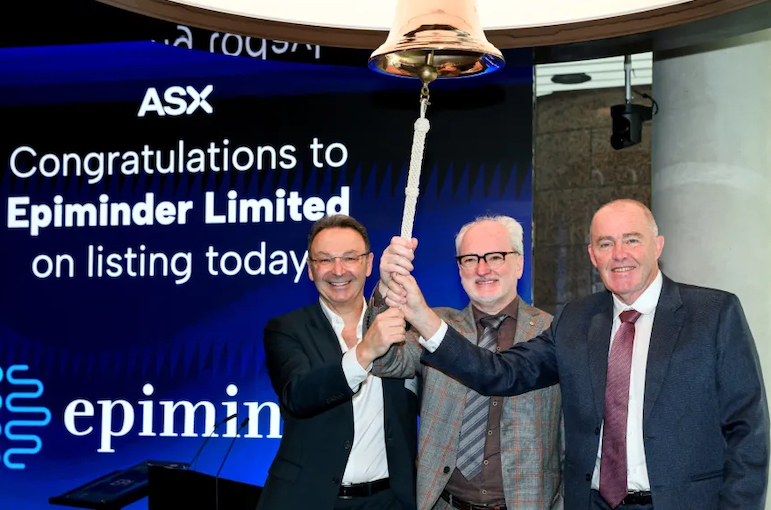
As omens go, epilepsy medtech Epiminder’s ASX debut on Monday, perhaps the stock exchange’s outage to start December wasn’t the best of signs.
A technical glitch meant price-sensitive announcements couldn’t be published for several hours and 50 ASX-listed companies were forced into trading halts.
Epiminder’s (ASX: EPI) initial public offering (IPO) at $1.50 per share got underway in the early afternoon, and the company lost more that 10% of its value to close at $1.34. The fall continued in Tuesday trade, down another 5% to $1.24.
The Melbourne-based startup was founded in 2017 by Mark Cook, the chief medical officer, based on research he led as far back as 2005 at the Bionics Institute and St Vincent’s/University of Melbourne. The epilepsy monitoring company raised $125 million for its IPO at a market capitalisation circa $325 million. The new funds are for theUS commercial rollout of its epilepsy monitoring device.
The medtech device company’s previous raises include $16 million in 2022, and Cochlear, the Bionics Institute, University of Melbourne and Seer Medical, are among its backers.
Cochlear, Epiminder’s largest existing shareholder, doubled down, taking another $10 million stake to lift its slice at listing to 36%, while The Bionics Institute is the second largest shareholder with 7.28%. Seer and Melbourne Uni have a combined holding of around 4.8%. All four companies have a three-year escrow on their shares.
The company’s Minder device is the first and only US FDA-authorised implanted continuous EEG monitoring system to check brain activity for epilepsy. Cochlear is making it for them.
Epiminder also scored a 2026 US Medicare reimbursement ruling for Minder at US$27,700, $5000 more than the original assessment.
Epiminder CEO Dr Rohan Hoare said going public was “a significant step” for the company’s goal of better patient outcomes for people with epilepsy.
“Successful treatment of epilepsy requires accurate, objective, longterm monitoring data and the Minder device is a minimally invasive monitoring system that fits into the dayto-day life of a person who manages epilepsy,” he said.
“The funds raised in the IPO will be used to commercialise the technology and develop the next generation of the device ahead of its full commercial rollout in the US from 1H 2028.”
Patient recruitment for a demonstration program, designed to prove clinical utility, health and economic benefits to patients, payers, and healthcare community, is also on the cards.








Daily startup news and insights, delivered to your inbox.