


















Sales of new battery electric vehicles (BEVs) in the first quarter of 2025 have fallen to 2023 levels, while demand for hybrid cars as nearly doubled over the past two years.
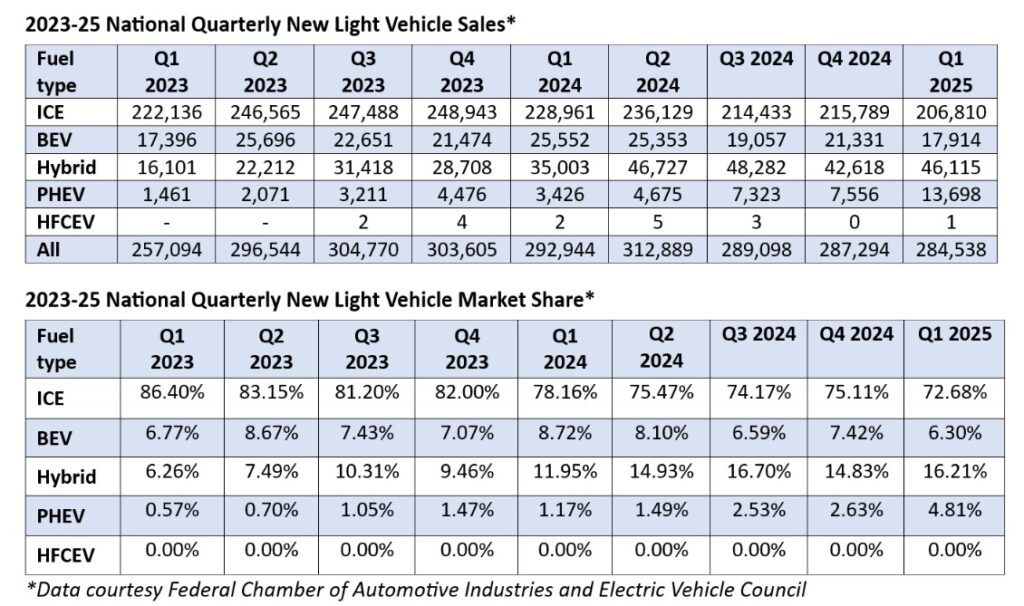
New figures from the peak motoring body Australia Automobile Association’s (AAA) quarterly EV Index reveal 17,914 BEVs were sold in the three months to March 31 – 6.3% of all new car sales – and a fall from 21,331 in the December 2024 quarter (7.42%).
Overall, national total vehicle sales fell by 0.96% in the March quarter, but according to the Electric Vehicle Council (EVC) figures, the biggest plunge for any brand was Elon Musk’s Tesla, down 59.65% to 5,160 cars in the 2024 quarter, although improved sales in the month of March prevented the drop remaining above 70% from January and Feb.
Model 3 sales fell 65% to 2046 cars, the Model Y by 54.44% to 3,114.
Tesla sales globally fell 13% for the quarter. Musk’s brand remains the BEV market leader in Australia, but its dominance has faded dramatically on 12 months ago, which represented more than half of all EV sales.
Combined sales of 5,160 for the Model Y and Model 3 represented less than a third (29%) of BEV sales in the quarter. The EVC also reported a 76% fall in Tesla sales in April.
Chinese rivals BYD and MG, combined with Korea’s Kia together now sell more BEVs that Tesla, and the AAA BEV sales and market share seem to have peaked for now, as government rebates for electric vehicles ended.
Meanwhile, buyers have turned to hybrid and plug-in hybrid (PHEV) cars, which nearly almost doubled on the December 2024 quarter, up from 7,556 to 13,698 vehicles in Q1 2025 (4.81%).
PHEV sales, while growing from a low base, have increased in eight of the past nine quarters.
In the first half of 2023, BEVs outsold hybrids nationally, but since then, hybrids have outsold BEVs in seven consecutive quarters.
Overall, hybrids represented 46,115 vehicle sales for the quarter.
Toyota dominates the hybrid market, with a majority of sales, while BYD leads the PHEV sector accounting for around one in every two vehicles sold.
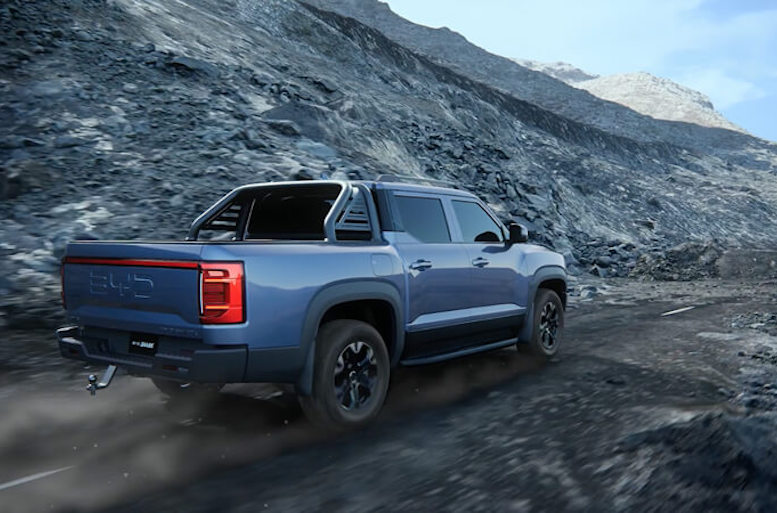
BYD released released Shark 6 4WD ute and sold 4,836 in the March quarter – 35.3% of total PHEV sales and 9.28% of total 4WD ute sales. The AAA believes the federal government’s exemption from fringe benefits tax, which ended in April 2025, helped boost sales. It also suggests that voters don’t believe EVs will “end the Australian weekend” as former Coalition leader Scott Morrison claimed back in 2019.
Medium SUVs remain Australia’s most popular vehicle segment and dominate the hybrid, BEV, and PHEV markets.
In the March 2025 quarter, about half (50.26%) of new medium SUVs sold were ICE (internal combustion engine); 29.88% were hybrids; 10.94% were BEVs; and 8.92% were PHEVs.
In the December 2024 quarter 76.7% of PHEVs sold were medium SUVs. But the arrival of the Shark 6 PHEV ute saw that figure fall to 46.9% in this quarter, even as total sales in this class rose 10.91% quarter-on-quarter (from 5,795 to 6,427).
Swinburne Professor of Future Urban Mobility Hussein Dia said the continuing and noticeable decline in petrol and diesel vehicle sales is a strong indicator that Australia is gradually transitioning towards cleaner transport solutions.
“The sharp upswing in hybrid vehicle sales, particularly plug-in hybrids, may have been largely driven by buyers who moved to secure vehicles ahead of the April 1 expiry of the fringe benefits tax exemption,” he said.
“While battery electric vehicle sales have softened slightly, this appears to reflect a temporary adjustment period as the market responds to the federal government’s New Vehicle Efficiency Standard (NVES), introduced in January.
“The overall market trajectory still points towards reduced reliance on internal combustion engines, with hybrids and electrics together capturing a growing share of new car sales. That is a positive and welcome trend in the context of national emissions reduction goals.”







Daily startup news and insights, delivered to your inbox.