


















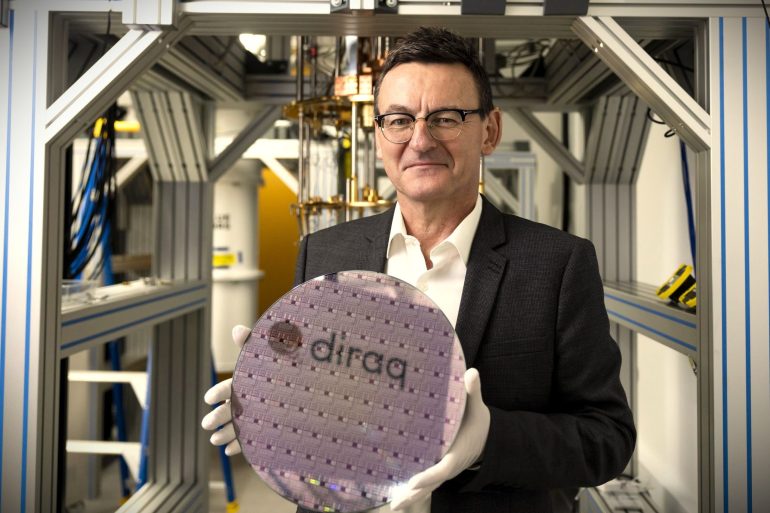
Australian quantum computing startup Diraq is heading to Chicago, having signed an agreement to set up in the Illinois Quantum and Microelectronics Park (IQMP) where it will join the likes of PsiQuantum and other deep tech firms.
Diraq was spun out of the University of New South Wales by CEO and founder Professor Andrew Dzurak.
“The Diraq mission is to design, build and deploy the world’s most cost-effective quantum computers, with the most compact footprint, allowing for mass deployment in data centers worldwide,” he said in a statement about the company setting up in Chicago.
“We recently set up operations in Silicon Valley and Boston, and we are looking at suitable options for expanding our presence. The IQMP represents an exciting opportunity that can support our U.S. growth strategy.”
Diraq’s core technology is a silicon-based, functionally scaled quantum processor that can be made with existing chip fabrication techniques. Its approach to building qubits also means they may be stable at temperatures higher than absolute zero – an important milestone for scalability and use.
Diraq was one of many home-grown quantum startups seemingly left out when the government decided to put all its eggs in the PsiQuantum basket.
The Chicago quantum campus where Diraq will set up shop will also be home to a PsiQuantum computer after the company was announced as an anchor tenant mid last year.
“Illinois continues to attract global quantum leaders due to its revolutionary spirit and skilled workforce, and because nothing like the IQMP exists,” said Intersect Illinois President and CEO Christy George.
“The campus is a direct result of our state’s bold and strategic vision to drive innovation and economic opportunity. We’re proud of our role in recruiting Diraq and are excited to see it progress in Illinois.”
Diraq has been linking itself closely with US government science and technology initiatives of late.
In March, it and particle physics laboratory Fermilab were awarded the US Department of Energy Quandarum project to help search for dark matter. The team will develop a quantum sensor to try and detect the hypothetical axion particle.
And just last month, Diraq was given an early stage contract with the US Defense Advanced Research Projects Agency (DARPA) as part of its Quantum Benchmarking Initiative. This is all about measuring the viability of different methods to developing quantum computers with a view to accelerating the sector’s development.
One of the main reasons governments are so keen on scaled quantum computing is its potential to crack modern encryption methods.






Daily startup news and insights, delivered to your inbox.