













Warning: this article contains mention of suicide.
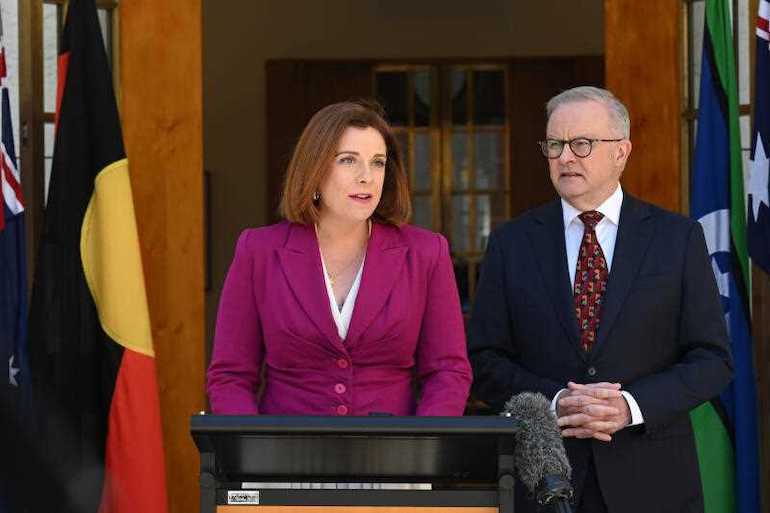
Ten months after Australia’s teen social media ban passed parliament, Communications Minister Anika Wells brought together 20 of the country’s top mental health groups to talk about the law at a roundtable.
“Today was a useful step for mental health organisations, peaks and government to get together and talk about what we are each doing in the 50 days left until the social media minimum age laws kick in,” Wells said at a press conference afterwards.
What the groups took away from the roundtable varied depending on who you spoke to (and Crikey spoke to a handful of participants at the meeting that day on the condition of anonymity).
One person relayed that they felt the government was laying at their feet the responsibility for the fallout of cutting hundreds of thousands of teens off from social media — a policy that many in the room had raised reservations with or opposed.
Another said that they felt more like it was a brief but rare opportunity to raise anything with the most powerful people in the country on this matter — in attendance were Wells, Minister for Mental Health Emma McBride and eSafety Commissioner Julie Inman Grant. But, they said, it was clear that asking for more money to address this was off the table.
The meeting encapsulated the awkward position of the mental health support sector when it comes to the teen social media ban.
Despite the government grounding its case for the “world-first” law in concerns about young people’s mental health and wellbeing, citing devastating case studies of young people who had taken their own lives, it was hard to find an existing reputable mental health support group that thought the ban was a good idea.
Concerns raised
Prior to the policy passing, none of the major mental health organisations supported a blanket ban. Each raised concerns about the harms of social media on young people, but cautioned that their effects were complex and the impacts of a ban unknown. They highlighted areas of social media to be addressed and reformed by the government, but stopped short of calling for children to be removed from platforms altogether.
In fact, several of Australia’s most prominent groups — Beyond Blue, Headspace, ReachOut and the Black Dog Institute — put out a joint statement raising their concerns that the ban would cut people off from accessing mental health support and would not make young people safer.
An open letter from 140 Australian and international experts opposing the ban was signed by a number of mental health researchers, too.
When the law passed, the sector — which tends to work closely with the government and relies heavily on it for financial support — put aside its opposition and began to work towards advising the government on how to implement the ban, and on preparing for the vulnerable moment for when teens were cut off from platforms that had been such a large part of their lives.
Even prior to Wells’ roundtable, many groups in the sector were already coordinating to avoid overlapping and producing redundant resources. As the year has gone on, these organisations have continued to look closely at the impacts of social media on mental health.
New research
In new research shown exclusively to Crikey, youth mental health group Orygen’s head of suicide prevention Professor Jo Robinson examined people’s exposure to suicide-related content on social media.
She found that more than half of the 3,500+ people surveyed had been exposed to suicide-related content on social media, despite just 19% of people having actively sought it out. This was worse for young people with experience of suicidal ideation, self-harm and suicide. About two-thirds of people said it worsened their mood.
But Robinson told Crikey that, perhaps counterintuitively, she didn’t view these findings as bolstering the case for a ban.
“There’s a nuance in this data that we really need to be thinking carefully about,” she said.
The study also showed that young people, including those experiencing suicidal ideation, are using social media to seek help.
“By banning these people from social media, you’re at risk of excluding some of these young people who might use it to get help,” she said.
Robinson worries that young people who are actively seeking out suicide-related content will find a way by circumventing the ban and finding alternative, murkier spaces to engage with the content.
She said this already happens now, recalling a young person telling her that they’ll go to darker places on the internet when they want to seek out suicide-related content that is already prevented by the major platforms.
This isn’t to say Robinson is happy with the state of major social media platforms and suicide content. She said research shows that algorithms will trap people in a suicide-content-related vortex, showing them more and more material that, by its nature, is highly engaging and emotive.
What about at 16?
While she wasn’t at the roundtable, Robinson says she wants to tell the government to rely on “well-designed research”, “robust evidence” and “youth’s lived experiences” for regulating social media — not just for teens but for everyone.
“On their 16th birthday, if young people are suddenly exposed to self-harm and suicide content on social media, how do we expect them to navigate it?” Robinson said.
“We urgently need to take action here, but simply restricting access to under-16s doesn’t adequately address this issue.”
In the meantime, the government has geared up its efforts to tell parents, carers and schools to prepare for teens who are being cut off from social media this week. Its $14 million advertising campaign launched last month sends people to the eSafety Commissioner’s website, which has prepared resources to assist.
The government points to its $1.1 billion announcement at the 2025 federal election as to how it plans to help young people who are losing contact with friends and communities online. Of this, $700 million is going to the mental health of young people, including $44 million for a national centre for youth mental health.
Wells told Crikey that the government has invested $130 million in digital mental health services that will fund help lines, web chats and other apps that will be available to teens post-ban.
For anyone seeking help, Lifeline is on 13 11 14 and Beyond Blue is on 1300 22 4636. In an emergency, call 000.
- This story first appeared on Crikey. You can read the original here.



Daily startup news and insights, delivered to your inbox.