


















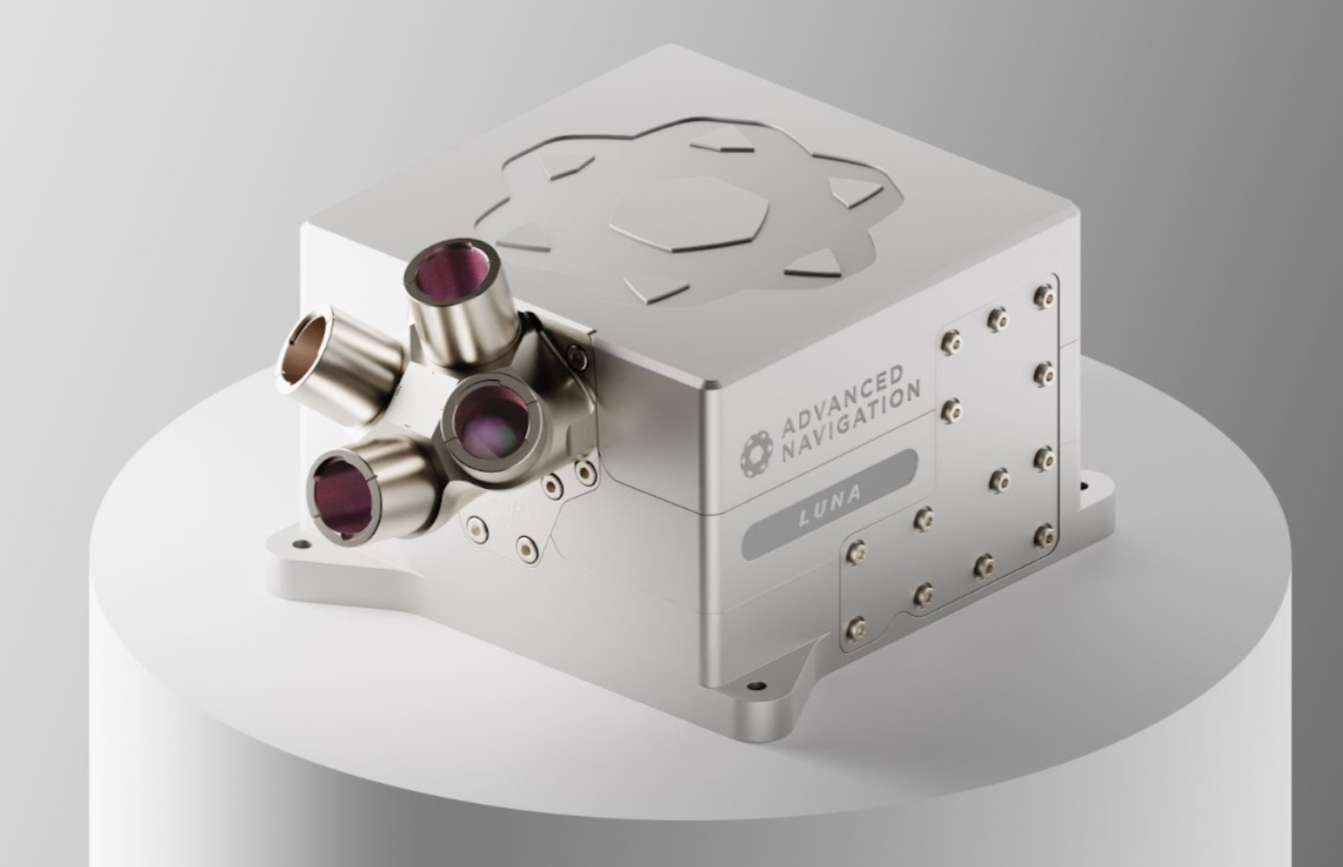
Advanced Navigation says its laser-based LUNA navigation sensor has passed a major round of Earth testingas it prepares for a mission to the lunar south pole with Intuitive Machines in 2027.
The Sydney-headquartered company positions LUNA as a “laser vision” unit that measures a lander’s 3D velocity and altitude relative to the surface, aiming to cut the drift and ambiguity that can creep into GPS-less lunar descents.
The company has been co-developing LUNA’s optical head with Australian Astronomical Optics (AAO) through Australian Space Agency funding.
“For decades, landing on the Moon has meant flying with only partial vision in the final kilometres,” said Chris Shaw, CEO and Co-founder of Advanced Navigation.
“With no GPS to guide them, landers depend on a combination of sensors that can introduce drift or deliver incomplete data – turning every descent into a high-stakes calculation where a single error could mean mission failure.”
“Our LUNA sensor aims to give lunar landers and rovers hyper-accurate ‘laser vision’ to see their own speed and position in the darkness of space, potentially making crashes a thing of the past and paving the way for safe, autonomous exploration. The technology delivers the predictability, reliability, and precision missions need.”
As part of its validation campaign, Advanced Navigation has recently demonstrated its hybrid, LUNA-derived terrestrial system in Europe’s deepest mine in Pyhäjärvi, Finland, reporting sub-percent position error in a GNSS-denied environment.
The company has also been tested over Western Australia’s Pinnacles Desert to simulate terminal descent dynamics, framing the sandy terrain as an analogue for lunar regolith.
Dr. Tim Crain, CTO of Intuitive Machines, said the lightweigh Advanced Navigation sensor “complements our precision landing technology by adding critical velocity and altitude data during descent.
“This TRL9 (technology readiness level) maturity of these technologies represents a significant advance for the Australian space industry at large.”
Enrico Palermo, Head of the Australian Space Agency shares this sentiment.
“The LUNA sensor is a testament to the talent and innovation within the Australian space sector and paves the way for our nation to play an even greater role in the future of lunar exploration,” he said.
Aussie space tech is currently in the spotlight as the global space industry lands in Sydney this week for the International Astronautical Congress.







Daily startup news and insights, delivered to your inbox.